Hyperliquid is building a global financial infrastructure that is credible and neutral. Anyone can build on top of it and list a market, and anyone can trade those markets at any hour. The past week's Nvidia story showed why that matters: most of the news, and then the earnings, landed outside regular trading hours, and Hyperliquid was one of the few places where people could trade it as it happened.
This piece goes through the market health of trade[XYZ]'s Nvidia market on Hyperliquid on earnings night: how closely its price tracked the stock and the Nasdaq open, how much it traded, how deep its book was, and what size someone could actually trade overnight.
Markets are moving toward 24/7 trading, something that has been needed for a long time. Hyperliquid is one of the pioneers of that shift, building the house of finance as credible, neutral infrastructure, and trade[XYZ] has done remarkable work on the market design that lets equities and other real-world assets trade around the clock.
We feel fortunate to watch it happen. This is a close look at one night of price discovery, in real time, on Hyperliquid.
Visit Hyperliquid Research and our HYPE Financial Dashboard with @hl_eco if you want to learn more about Hyperliquid.
–
Nvidia reported its first quarter since Jensen Huang's resignation at 4:20 PM ET on Tuesday, 20 minutes after the regular session closed and 17 hours before the next one opened. Revenue of $115.8B beat estimates of about $109B, and fourth-quarter guidance of $130.0B topped a consensus just over $125B.
On Hyperliquid, trade[XYZ]'s Nvidia perpetual, xyz:NVDA, repriced in the release minute on $46.8M of volume, 31 times its usual pace. Through the evening it stayed a median 2.6 bps from Nvidia's after-hours price. It traded more in the four hours after the close ($439.2M) than during the whole regular session that day ($362.5M), and kept trading overnight. Its order book thinned in the release minute and was back above $2.5M within 10 bps of mid three minutes later. Its last price before Wednesday's open, $159.29, was 6.3 bps from Nasdaq's opening print of $159.19.
1. The News Broke Outside Market Hours
Earnings night capped a week in which five of the six headlines that moved Nvidia landed outside regular trading hours, from the board's investigation memos on a Sunday to Huang's resignation before the Thursday open (Exhibit 1). Each of those times, xyz:NVDA was where the news was priced first. Of the $7.4B it traded from November 6 to Wednesday morning, $4.0B changed hands outside the regular session.
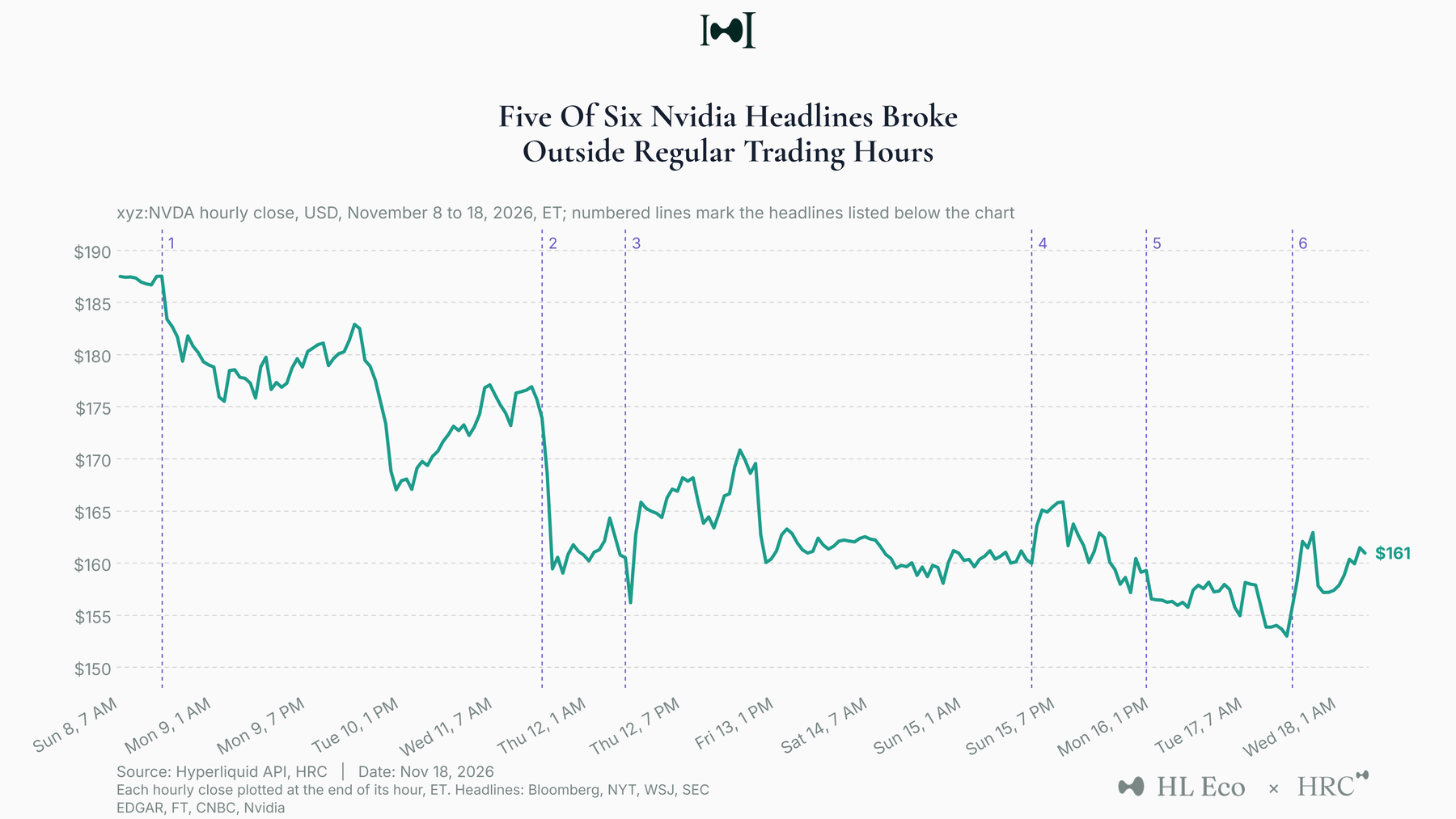
Exhibit 1. Five of six Nvidia headlines broke outside regular trading hours. (1) Sun Nov 8, 3:23 PM: Bloomberg publishes board memos. (2) Wed Nov 11, 4:55 to 5:28 PM: NYT and WSJ report the board is moving to oust Huang. (3) Thu Nov 12, before 9:00 AM: 8-K, Huang resigns. (4) Sun Nov 15, 2:03 PM: FT, Huang discusses a comeback. (5) Mon Nov 16, 12:38 PM: CNBC, board not considering his return. (6) Tue Nov 17, 4:20 PM: earnings. All times ET. Source: Hyperliquid API, Bloomberg, NYT, WSJ, SEC EDGAR, FT, CNBC, Nvidia. Date: November 18, 2026.
2. The Print
Nvidia published at 4:20 PM ET, and the SEC accepted the 8-K 51 seconds later. In that minute, xyz:NVDA spiked to $161.49 and closed at $158.67, up 2.2%. On the call, chairman Harvey Jones said the board "does not intend to reinstate Jensen as CEO", and the contract rose another 2.1% in one minute. It peaked at $163.76 at 6:14 PM ET, 5.5% above its pre-release price (Exhibit 2).
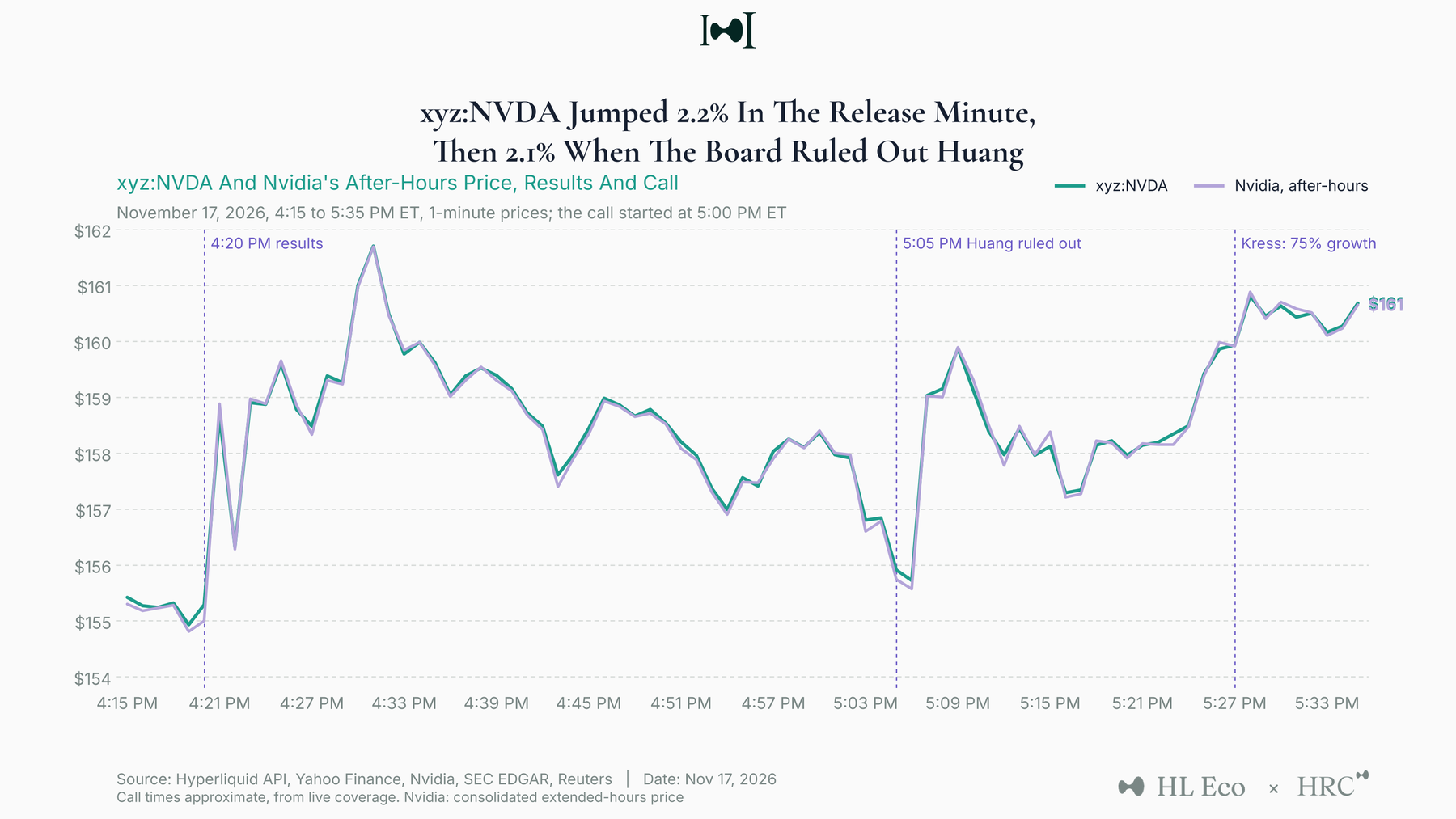
Exhibit 2. xyz:NVDA moved with Nvidia's after-hours price through the release and the call. Source: Hyperliquid API, Yahoo Finance, Nvidia, SEC EDGAR, Reuters. Date: November 18, 2026.
3. Does It Track Nvidia?
From the release to 8:00 PM ET, the median gap between xyz:NVDA and Nvidia's after-hours price was 2.6 bps, the average 3.4 bps, and 80% of minutes were within 5 bps. The widest gaps, 18.7 bps in the release minute and 16.4 bps during the call, closed within a minute or two (Exhibit 3).
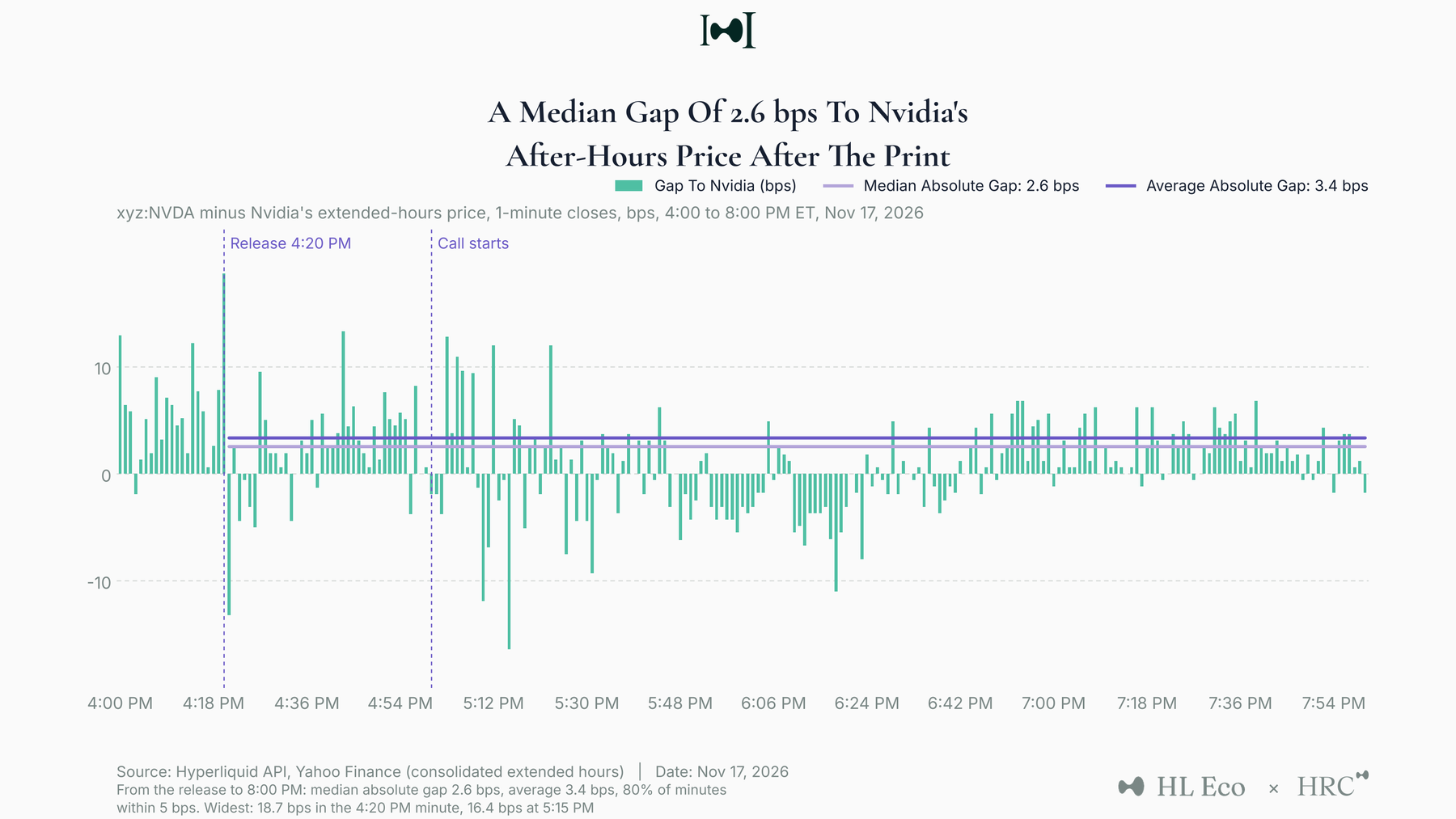
Exhibit 3. xyz:NVDA traded a median 2.6 bps from Nvidia's after-hours price after the print. Source: Hyperliquid API, Yahoo Finance. Date: November 18, 2026.
Overnight, Nasdaq is shut, but Nvidia keeps trading on overnight venues, and xyz:NVDA's oracle follows that price. Through the night, xyz:NVDA stayed within a few basis points of it, and when pre-market trading opened at 4:00 AM ET, the two were about 4 bps apart. At 9:29 AM it was at $159.29, 6.3 bps from Nasdaq's opening print of $159.19, in line with the week's other opens (Exhibit 4). Like the after-hours tape, it overshot in the evening, pricing about twice the eventual move by 8:00 PM, then gave the excess back overnight.
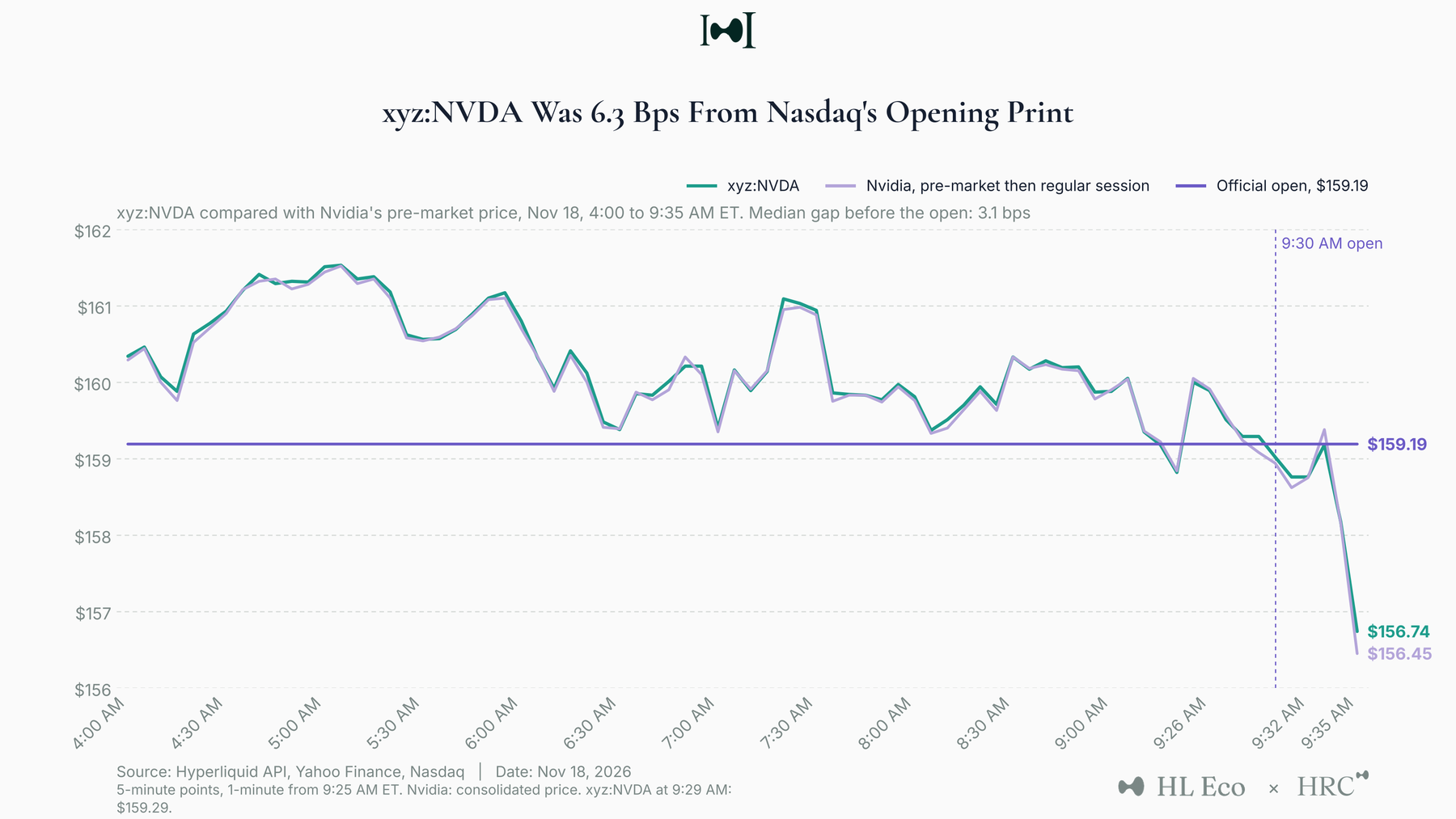
Exhibit 4. xyz:NVDA stood 6.3 bps from Nasdaq's opening print, compared with Nvidia's pre-market price, November 18, 4:00 to 9:35 AM ET. Source: Hyperliquid API, Yahoo Finance, Nasdaq. Date: November 18, 2026.
4. Can You Trade Size, And At What Cost?
Spreads barely move across sessions. From November 1 to 11, the median xyz:NVDA spread was 0.5 to 0.6 bps in every session, weekends included. Depth is what changes: the median book held $2.2M within 10 bps of mid during regular hours and $1.1M to $1.2M after hours and pre-market (Exhibit 5). A $100K order cost a median 1.3 bps of price impact in the regular session and 1.8 bps after hours.
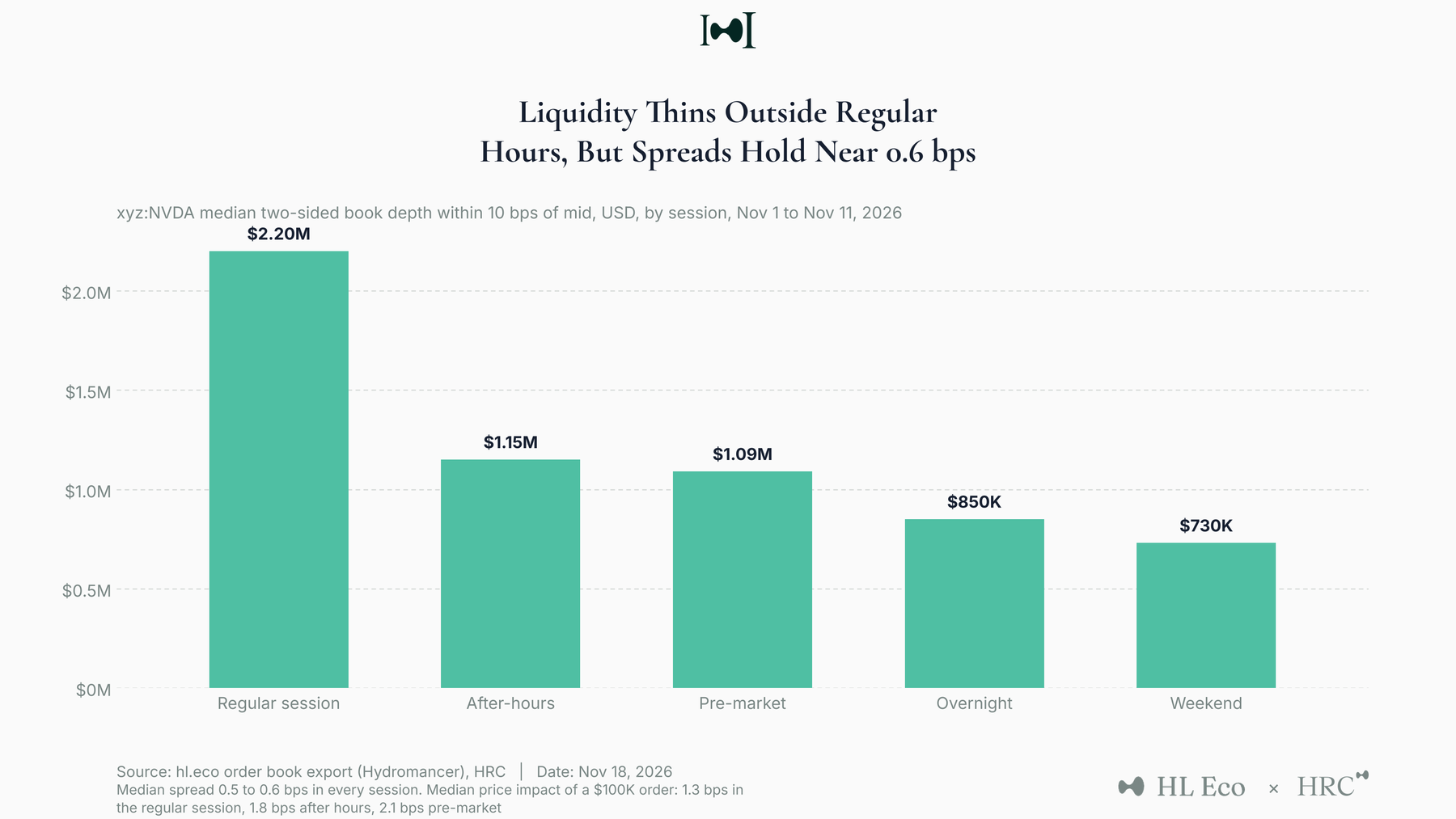
Exhibit 5. Liquidity thins outside regular hours, but spreads hold near 0.6 bps. Source: hl.eco order book data (Hydromancer). Date: November 18, 2026.
Earnings night tested the book. Before the print, a $1M order cost about 4 bps. The release emptied the book for a moment, but it refilled within three minutes. The call hit harder: when the board ruled out Huang's return, the book stayed thin for about half an hour and a $1M order cost 15 to 18 bps. By 5:45 PM ET it was back to normal, and it stayed deep through the evening (Exhibit 6). Wednesday's open was a smaller repeat: the book thinned for a few minutes as the regular session opened, then refilled by 9:40 AM.
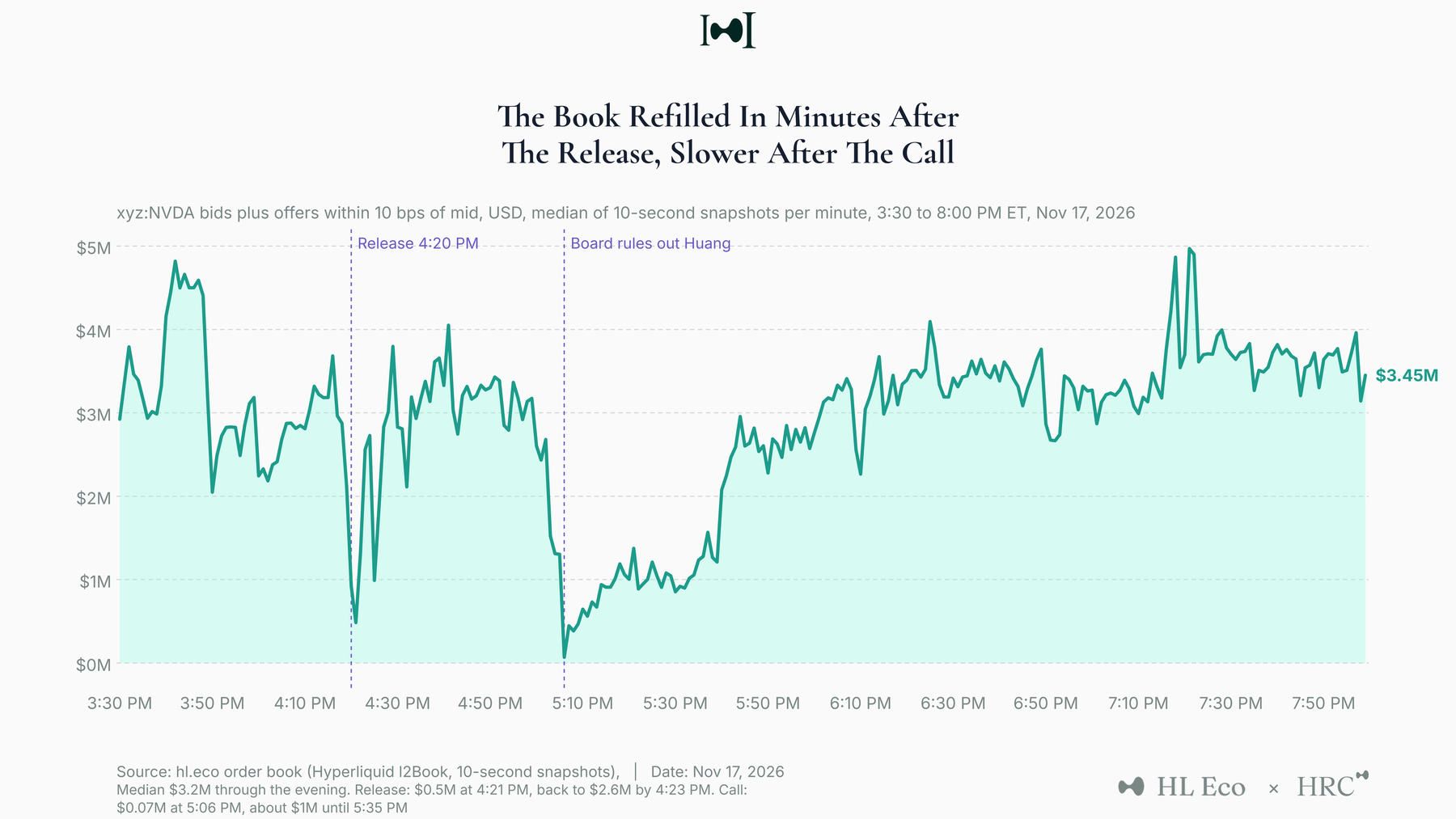
Exhibit 6. The book refilled in minutes after the release, more slowly after the call. Source: hl.eco order book data (Hyperliquid l2Book, 10-second snapshots). Date: November 18, 2026.
Holding a long also costs funding, paid to shorts every hour. Over the 24 hours to 5:00 AM ET on Wednesday, it averaged 10.1% annualized, about $28 a day per $100,000 of position, in a range of 5.5% to 22.1%, compared with a 7-day average of 18.0%, which was lifted by funding spikes after the Huang headlines (Exhibit 7). Open interest fell 15.4% in contracts between the release and the open, from 3.03 million to 2.56 million ($469.0M to $407.9M), as traders took risk off rather than added leverage.
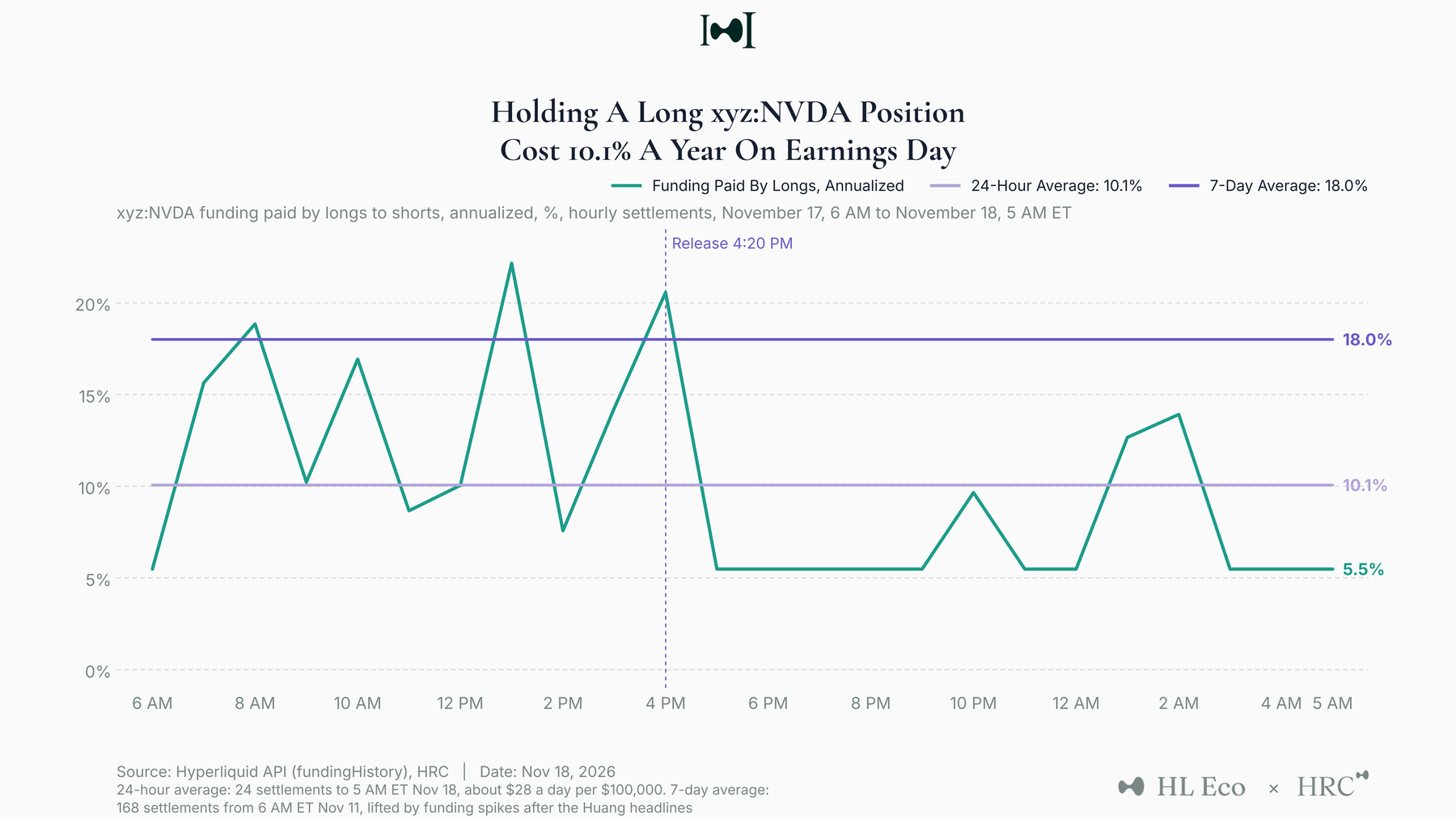
Exhibit 7. Funding paid by longs on xyz:NVDA, annualized, with the 24-hour average (24 hourly settlements, November 17, 6:00 AM to November 18, 5:00 AM ET) and the 7-day average (168 settlements from November 11, 6:00 AM ET). Source: Hyperliquid API (funding history). Date: November 18, 2026.
5. Equities Driving Hyperliquid
On the day Huang resigned, HIP-3 markets, where builders such as trade[XYZ] list equities, indices and commodities, handled 51.6% of the exchange's perp volume, and its 7-day average reached 42.1%, the highest since August and more than double its September low (Exhibit 8). xyz:NVDA alone was 34.1% of HIP-3 volume that day.
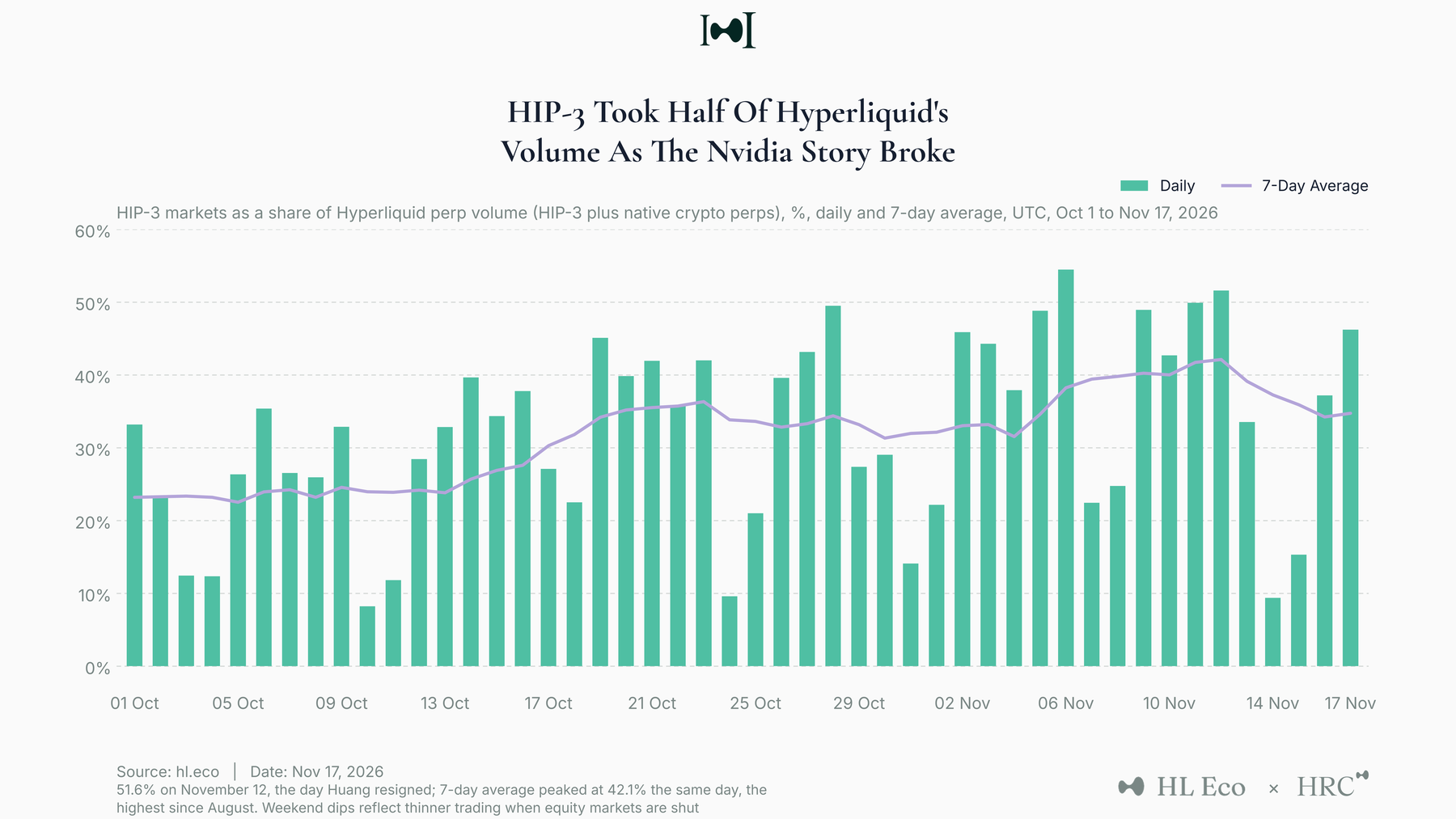
Exhibit 8. HIP-3 took half of Hyperliquid's volume as the Nvidia story broke, daily and 7-day average. Source: hl.eco. Date: November 17, 2026.
6. Next: Anthropic
Over the week, xyz:NVDA was where Nvidia news was priced first, and it was 6.3 bps from Nasdaq's opening print.
Anthropic is expected to list on Nasdaq on November 19 after marketing 825 million shares at $70 to $78, in what would be the second-largest IPO on record, behind SpaceX in June. At 10:39 AM ET on Wednesday, xyz:ANT traded at $97.14, 24.5% above the top of the range, implying about $1.7 trillion on 17.5 billion fully diluted shares, against $1.22 trillion to $1.36 trillion for the range. Thursday's open will show how close Hyperliquid's price was.
Appendix: How xyz:NVDA Works
xyz:NVDA is a perpetual future on one Nvidia share, margined in USDC and settled on Hyperliquid's onchain order book. On weekdays, including after-hours and overnight, its oracle is the external market price for Nvidia, updated about every 3 seconds. From Friday 8:00 PM to Sunday 8:05 PM ET, the oracle tracks trading on the xyz:NVDA book itself. Margin and liquidations use a mark price, the median of three inputs, which can move at most 0.5% per update. Hourly funding pulls the contract back toward the stock (Exhibit 9).
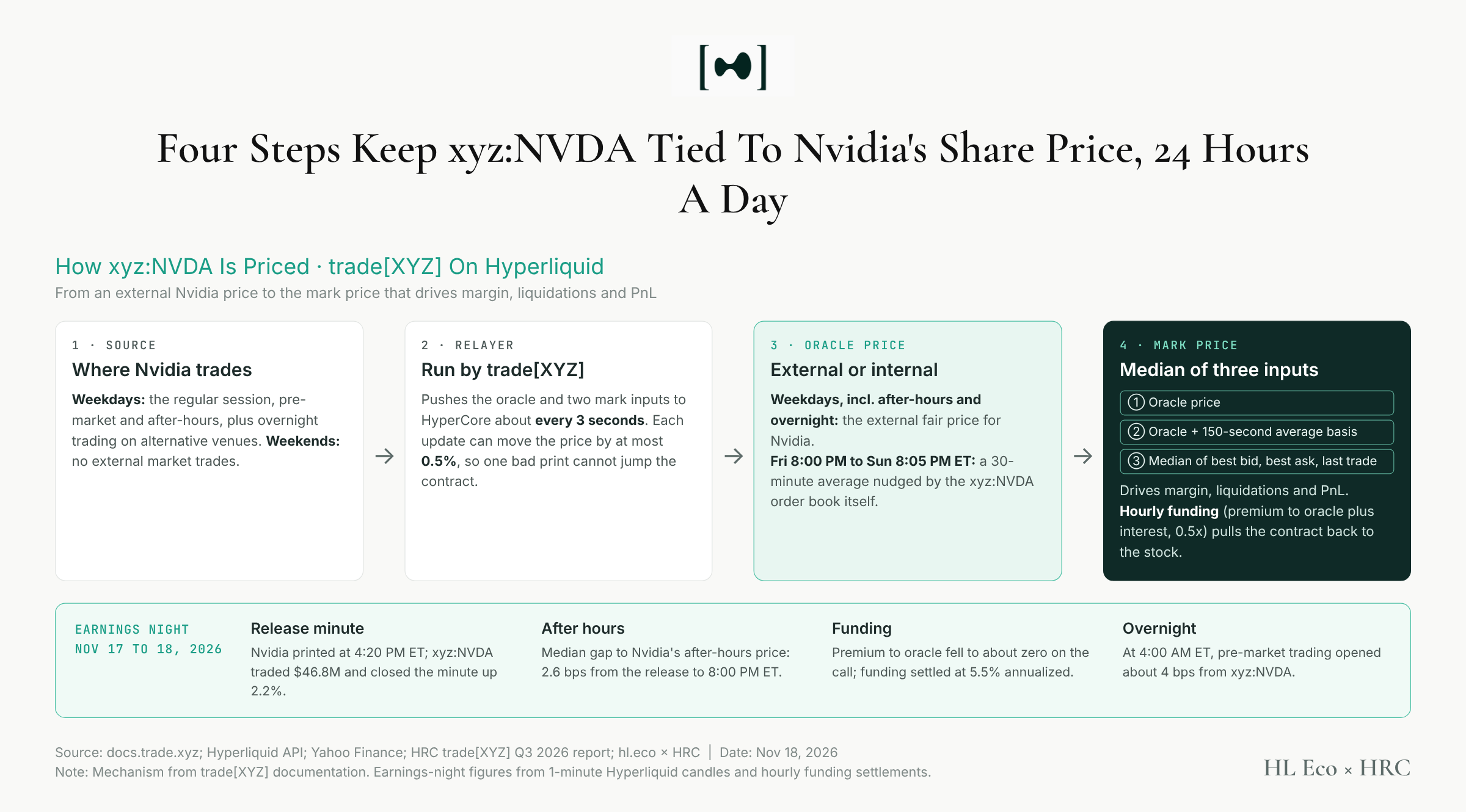
Exhibit 9. How xyz:NVDA is priced. Source: docs.trade.xyz, Hyperliquid API, Yahoo Finance, HRC. Date: November 18, 2026.