Hyperliquid / EcosystemPermissionless Deployment Triples HIP-4 Volume, With Permission the Remaining ConstraintHyperliquid opened its prediction market layer to third-party venues on August 29 and daily volume tripled to a trailing $2.75 million. Deployment is now permissionless on-chain. Market access is not, on three separate regulatory tracks.Four Pillars·Sep 3, 2026
RegulationPerpetual Contracts Belong at the Center of the CFTC's Innovation AgendaHPC submitted a statement to the CFTC's Innovation Advisory Committee today: perpetual contracts are central to the innovation agenda, serve real-world hedging needs, and are already onshoring under the Commission's 2026 policy moves. $500B+ in notional volume on Hyperliquid alone says the demand is already here.Hyperliquid Policy Center·Aug 27, 2026
Regulation / Trade[XYZ] & RWA PerpetualsHPC and trade[XYZ] Ask the CFTC to Bring Energy Perpetual Contracts to U.S. MarketsHPC and trade[XYZ] filed a joint comment letter urging the CFTC to bring energy perpetual contracts into regulated U.S. markets, pointing to $500B+ in trading volume and a February oil shock that U.S. futures couldn't react to over the weekend.Hyperliquid Policy Center·Aug 26, 2026
RegulationHPC Urges the SEC and CFTC to Adopt a Harmonized Framework for Perpetual ContractsFor a product trading hundreds of billions in volume, perpetual contracts still don't have a settled answer to the most basic question under U.S. law: are they futures, or are they swaps? One federal judge described the exercise as deciding "whether tetrahedrons belong in square or round holes." In a new comment letter to the SEC and CFTC, HPC argues the fix has been sitting in plain sight — treat qualifying equity perpetuals as security futures, a category both agencies already oversee, and let exchanges compete on execution instead of jurisdiction. The stakes: more than $480 billion in perpetual contract volume that's traded on Hyperliquid over the past ten months alone, waiting on a framework that lets it come onshore.Hyperliquid Policy Center·Aug 24, 2026
Hyperliquid / Trade[XYZ] & RWA PerpetualsThe Great PerpificationEvery few cycles, a crypto-native idea slips its leash and rewires a slice of the real world. Digital gold did it. Stablecoins did it. Monk and Ryan Watkins are betting perpetual derivatives are next, and that decentralized exchanges like Hyperliquid are the ones built to carry them there. Retail traders drowning in options theta decay and opaque CFD spreads don't need a fancier derivative, they need a simpler one: no expiries, no strikes, just leverage that does exactly what it says on the tin. The math is the hook: even a sliver of the $8 trillion sloshing through daily options, futures, and CFD volume flipping onchain is worth hundreds of billions in market cap. They've got a name for it already: the great perpification.Syncracy Capital·Aug 22, 2026
Hyperliquid / RegulationPerpetual Futures as Complements to Dated FuturesPerpetual futures are entering the U.S. market for the first time, raising an important question: do they compete with traditional futures markets, or complement them? New research from the Hyperliquid Policy Center finds that perpetuals expand hedging opportunities, lower barriers to risk management, and provide valuable price discovery during off-hours, with no statistically significant evidence of harm to benchmark markets.Hyperliquid Policy Center·Aug 21, 2026
Financials / HyperliquidHYPE Regulatory Overhang Is Gone: Onwards and UpwardsYesterday Trump named Hyperliquid directly from the White House: Selig at the CFTC is working to bring it into the US, fully compliant and legal. That single sentence removes the biggest overhang standing between HYPE and its full thesis playing out: access to the largest capital market on earth. The fundamentals were already strong. Now the ceiling just got a lot higher. Here's why.GLC Research·Aug 20, 2026
Trade[XYZ] & RWA PerpetualsHPC and trade[XYZ] Introduce Pre-IPO Perpetuals to the SECAmericans should have access to pre-IPO perpetuals. Cerebras opened 89% above its IPO price. SK Hynix 14%. SpaceX 11%. Each time, a public market on Hyperliquid signaled the gap before trading began.IPO modernization offers a chance to put that price signal to work for issuers and investors. Today, with @tradexyz , we filed a joint comment letter introducing pre-IPO perpetuals (IPOPs) to the SEC. Inside, we describe the five IPOP markets that trade[XYZ] has launched so far on Hyperliquid and outline the questions that the SEC must resolve before these markets can serve Americans.Hyperliquid Policy Center·Aug 18, 2026
RegulationHPC and Douro Labs Back the SEC's Move to Retire the Trade-Through RuleEquity market structure was built for the technology of another era. As the SEC considers rescinding Rule 611 of Regulation NMS, onchain markets have an opportunity to reshape how securities trade in the U.S. This article explores why the existing framework struggles with onchain execution, how best execution rules could evolve, and the role independent reference prices like Pyth could play in bringing tokenized equities and other financial markets onchain.Hyperliquid Policy Center·Aug 17, 2026
RegulationHPC Files Statement in Connection with CFTC Agricultural Advisory Committee MeetingHPC advocates for regulations that allow Americans to access onchain markets, including those for perpetual futures. Our goal is to ensure that end users in the U.S. derivatives markets can benefit from innovative technologies and novel products such as these.Hyperliquid Policy Center·Aug 7, 2026
RegulationHPC and Phantom Ask the CFTC to Make Room for Onchain Market InfrastructureToday, HPC and Phantom filed a joint comment in response to the CFTC’s request for information to carry that distinction into onchain markets. We support the Commission’s decision to examine whether its rules remain fit-for-purpose as financial technology evolves, and write to recommend that it tailor its rules so that developers can build, registrants can modernize, and regulation falls on the firms actually performing regulated financial activities.Hyperliquid Policy Center·Jul 9, 2026
HyperliquidThe Almanack of HyperliquidThis essay is not about price predictions, how big Hyperliquid will be in the future, or why you should or shouldn't buy. This essay is about exactly how Hyperliquid is different, not only from perp DEXes and CEXes, but also from almost every other protocol in this space, and why you should at least get familiar with it.Pavel Paramonov·Jun 15, 2026
FinancialsOutstanding Token Supply: How We Count HYPE TokensIn this report, we present Outstanding Token Supply (OTS), a framework designed to capture the tokens that represent actual claims on Hyperliquid's value today. By separating future allocations from committed ownership and permanently retired supply, OTS provides a clearer lens through which to evaluate Hyperliquid's market capitalization and valuation.Hyperliquid Strategies Inc·Jun 15, 2026
HyperliquidHyperliquid Through a TradFi Lens: Weekend Markets, Builder Codes, and Transparent RulesHyperliquid Strategies Inc is a digital asset treasury company. We hold HYPE on our balance sheet, we are listed on the Nasdaq, we stake and deploy our HYPE in the Hyperliquid ecosystem to earn yield and the primary thing our shareholders own when they own us is exposure to the Hyperliquid ecosystem in an equity wrapper. That is an accurate description of what we are. It is not a complete description of everything that we do.Hyperliquid Strategies Inc·May 22, 2026
HyperliquidTwo Weeks of HIP-4: A Forensic Look at Hyperliquid's Outcome MarketsHyperliquid recently launched HIP-4: a new market type for binary outcomes that resolve to Yes or No against a real-world condition. We tracked HIP-4 for the first two weeks of it being live: 18 daily BTC binary outcomes, 6,101 wallets, 28.1 million orders, 908 thousand fills, and 4.64 million orderbook snapshots.Arrakis·May 22, 2026
Trade[XYZ] & RWA PerpetualsWhat Trade.xyz's Cerebras market tells us about the Pre-IPO summerCerebras ( $CBRS ) announced its IPO issue price at $185 a share on May 13th, against books reportedly 20x oversubscribed. Thirty million shares cleared at an implied market capitalisation above $48 billion, the largest US technology offering of the year. Only, a fraction of this allocation reached retail accounts.Arrakis·May 16, 2026
EcosystemKey Takeaways from Hyperliquid Strategies (NASDAQ:$PURR) Second Earnings CallHyperliquid Strategies' second earnings call highlighted accelerating HIP-3 and Trade[XYZ] momentum, a widening independence between $HYPE and broader crypto markets, and a new validator partnership with Unit Labs. Management also detailed continued treasury deployment and a strong quarter driven by HYPE's price performance.GLC Research·May 8, 2026
HyperliquidHIP-4 Outcome MarketsHIP-4 is Hyperliquid’s new primitive for outcome markets, extending HyperCore beyond spot and perpetuals into dated, fully collateralized contracts that settle to a bounded value at expiry.shaunda devens·May 7, 2026
RegulationHPC Files Comment to the CFTC’s ANPRM on Prediction Markets Today, HPC filed a comment letter with the Commodity Futures Trading Commission (“CFTC” or “Commission”) in response to its Advance Notice of Proposed Rulemaking on Prediction Markets (the “ANPRM”).Hyperliquid Policy Center·Apr 30, 2026
Trade[XYZ] & RWA PerpetualsWho is actually trading on Trade.xyz? We classified each wallet based on their trading behaviour over past 3 months: addresses with maker-dominated were classified market makers, addresses with high-frequency taker activity were classified arbitrageurs, addresses with low fill rates and builder tagged orders were deemed retail. While this revealed interesting pattens in the market structure, this classification was probabilistic, and the method left roughly 70% of wallets in the market unclassified.Arrakis·Apr 29, 2026
RegulationAdvancing Policy for the House of All Finance Hyperliquid represents the next era of market evolution.Hyperliquid Policy Center·Apr 22, 2026
Trade[XYZ] & RWA PerpetualsRWAs Aren't Coming Onchain. They're Already Here.HRC held its first offline meetup in Seoul last week. As part of the event, GLC Research gave a small presentation on Trade.XYZ and equity perpetuals on Hyperliquid. For those who couldn't make it, the full talk is below.GLC Research·Apr 15, 2026
EcosystemUSDH: The Path to $10B?USDH generates ~$0.006/HYPE in annual buyback yield at $91M supply, a rounding error against $600M+ in trading fee buybacks. It stays immaterial until supply crosses $1.5B.Four Pillars·Apr 10, 2026
Trade[XYZ] & RWA PerpetualsWho is trading on HIP-3?An analysis of orderflow across seven HIP-3 perpetual markets on Hyperliquid, 175,000 wallets, $161B in volume, and the frontends routing it all.Arrakis·Apr 8, 2026
EcosystemIntroducing: Zero-fee on & offramps to Hyperliquid with USDH.comToday, we are expanding access to our zero fee + zero slippage on & offramp on dashboard.USDH.com, starting with US bank and brokerage accounts.Native Markets·Apr 8, 2026
Trade[XYZ] & RWA PerpetualsCan Hyperliquid Predict the S&P 500?On March 18th, 2026, trade.xyz launched the first officially licensed S&P 500 perpetual futures contract on Hyperliquid, in collaboration with Standard & Poor’s. We analysed the microstructure of this market to test whether trading activity from it contains information that can accurately predict the near-term direction of S&P 500.Arrakis·Mar 28, 2026
HyperliquidHyperliquid: HIP-4 and Outcomes Nobody Talks AboutHIP-4 is often viewed as a prediction markets update for Hyperliquid, but that's not entirely accurate. It's an "options" update, not just a "prediction markets" update. This essay shows why HIP-4 despite its popularity among the masses is still an underrated update, what next HIPs will highly likely be about and why HIP-4 will probably become the biggest update in Hyperliquid's history.Pavel Paramonov·Mar 27, 2026
Trade[XYZ] & RWA PerpetualsThe Evolution of CommoditiesState of comondities and quantitative analysis of the growth of these markets onchain. Commodities are the oldest traded asset class in human history and among the most consequential, given their impact on the real economy. Yet for all their importance, the infrastructure they trade on has evolved incrementally at best. Markets are still shut on weekends and holidays, and access still runs through layers of intermediaries built for a pre-Internet world.The next rails are onchain.Castle Labs·Mar 26, 2026
Trade[XYZ] & RWA PerpetualsFor 49 Hours During the Iran Strikes, Hyperliquid Was the Only Liquid Oil MarketOn February 28, 2026, the United States and Israel launched aerial strikes against Iran. It was a Saturday. Every commodities exchange in the world was closed. The only liquid venue where crude oil could be traded was Hyperliquid, a blockchain-native perpetual futures exchange running 24/7.Arrakis·Mar 24, 2026
HyperliquidHyperliquid: The Emergent Infrastructure for Global FinanceA Comprehensive Analysis of Technical Architecture,Market Dynamics, and the Path to Becoming “The House of All Finance”.GRZ Research·Mar 15, 2026
Trade[XYZ] & RWA PerpetualsHIP-3 Today: Where we are and where we're goingHIP-3 has moved beyond a speculative narrative and into a weekend price discovery venue for oil, silver, and more major off-chain assets. But HIP-3 is not even six months old, and the 24/7 first crude oil market launched via HIP-3 is barely two months old. How did we get here, and where might HIP-3 go from here? In this brief piece, I’ll walk through the HIP-3 ecosystem as it stands today across markets, deployers, access points, coverage, etc.Charlie.hl·Mar 12, 2026
EcosystemHYPE, PURR, HYPD: Anatomy of a 39bp SpreadThree months in, 39 points separates two Nasdaq-listed vehicles holding the same asset. The gap comes down to three structural variables in order: warrant topology, accretion rate, mNAV.Four Pillars·Mar 10, 2026
RegulationJake Chervinsky on HPC, Perps, and the Fight for DeFi in AmericaThe regulatory landscape around Hyperliquid, perpetual futures, and DeFi broadly is moving fast, and it can be difficult to separate signal from noise. This article aims to cut through that and give readers a clear, up-to-date picture of where things stand: what the current regulatory environment looks like, what the Hyperliquid Policy Center is and what it is trying to accomplish, and what Jake Chervinsky shared in his latest interview with Flood. Whether you are new to the topic or closely following developments, our goal is to make this accessible and keep you informed as things continue to evolve.GLC Research·Mar 5, 2026
Trade[XYZ] & RWA PerpetualsHow informed are Hyperliquid traders on weekends?As 24/7 markets for traditional assets continue to grow on Hyperliquid, one key question emerges: do weekend prices actually reflect real information, or are they just noise? In this piece, Matteo dives deep into high-frequency data across commodities, equities, and indices to assess the quality of price discovery on HIP-3 markets. The results are striking with near-perfect directional accuracy and minimal deviation from traditional market opens, even during periods of extreme volatility.matteo·Mar 3, 2026
Trade[XYZ] & RWA PerpetualsHow HIP-3 Korea Perps Onboard InstitutionsKorean megacaps SK Hynix and Samsung don’t have a real US-hours single-name market. Hyperliquid’s HIP-3 perps for Samsung and SK Hynix have a path to become the missing layer: the US-hours reference price that the rest of the stack can anchor to.Walter·Feb 23, 2026
EcosystemKey Takeaways from Hyperliquid Strategies (NASDAQ:$PURR) First Earnings CallHyperliquid Strategies’ first earnings call highlighted aggressive HYPE accumulation, a strong treasury position, and a valuation-driven capital allocation strategy across both HYPE and PURR. Management emphasized upcoming catalysts such as BLP and HIP-4, while positioning PURR as both an access vehicle for U.S. investors and a growing strategic participant within the Hyperliquid ecosystem.GLC Research·Feb 11, 2026
HyperliquidHyperliquid announcing HIP-4: "The payoff canvas of HIP-4"HIP3 silver markets have grown to 2-3% of CME activity and have begun to show signs of weekend price discovery. And combined with unified accounts and portfolio margin, the UX inefficiencies of converting collateral to trade different markets are getting resolved. Now HIP4 expands the second dimension of trading: the payoff function for markets.Walter·Feb 10, 2026
EcosystemPURR’s HYPE Bid Is Not What You Think Most people track PURR (previously called Hyperliquid Strategies or HSI) for one reason: it’s one of the HYPE DATs (actually the biggest one) accumulating HYPE. So the mental model is simple: “PURR still has many millions to hold or pump the price.” That model is useful. It’s also incomplete.Ericonomic·Feb 5, 2026
HyperliquidHIP-4: Making All Markets HyperliquidThis HIP allows @HyperliquidX (HL) to extend its support for instruments beyond perps, supporting binary market outcomes. This is increasingly important, as it allows HL to tap into one of the most active areas of crypto: Prediction Markets (PMs).Castle Labs·Feb 3, 2026
HyperliquidUnderstanding Hyperliquid's Architecture: HyperBFT, HyperCore, and HyperEVM (Part 1)Berenu·Jan 30, 2026
Trade[XYZ] & RWA PerpetualsTrade.xyz: Real Growth or Commodities-Fueled Mirage?XYZ is a decentralized, non-custodial perpetual futures platform built on Hyperliquid's HIP-3 infrastructure. It enables users to trade crypto, stocks, indices, forex, and commodities 24/7 using leveraged perpetual contracts—all without depositing funds to a centralized entity.Pine Analytics·Jan 27, 2026
EcosystemDesigning Felix Spot EquitiesFelix spot equities will give traders access to over 100 US equities and ETFs at launch with NYSE/Nasdaq liquidity for each. How? In this brief article, we will walk through the design implementation of Felix spot equities. More technical information + FAQs will be answered in documentation soon.Felix·Jan 26, 2026
FinancialsWhat Actually Broke HYPE and What Changes From HereOver the last two months, HYPE fell from the $45–50 range to ~$20. That move wasn’t random, and it wasn’t just “market conditions”. It was the result of three very specific sources of sell pressure, all of which were visible on-chain and are now either resolved or close to exhaustion. This article breaks down what actually happened and why the setup going forward is structurally different from what it was two months ago.Ericonomic·Jan 26, 2026
FinancialsHyperliquid Fundamentals Update: “10/10 Recovery, Momentum, and What’s Next”Hyperliquid was not spared during the liquidation cascade of October 10. It was a brutal event that impacted traders and market participants across the industry. In the aftermath, trading activity declined broadly, with lower volumes observed across both centralized exchanges and DEXs. In this analysis, we take a closer look at where Hyperliquid stands today. We analyze its core metrics and assess how Hyperliquid has been recovering from the October 10 liquidation event.GLC Research·Jan 19, 2026
EcosystemWhy HyENA and What’s Next Perps trading has evolved a lot over the last few years. Matching engines got faster. New types of pairs are traded, such as pre-markets, commodities, and (now, increasingly) equities. Centralized exchanges pioneered portfolio margin, so that crypto collateral such as BTC and ETH can act as margin alongside stablecoins. If collateral rewards becomes a default option on the leading decentralized perps venue, the benefits accrue not only to HyENA or Ethena, but to the broader community of traders, desks, and builders on Hyperliquid.HyENA·Jan 8, 2026
EcosystemBuilding Yield Exchange Perpetual instruments on Hyperliquid’s HIP-3Based has always been more than a trading front-end: we’re building a SuperApp where trading, yield, and real-world utility sit in one place, and where every new product surface makes the whole ecosystem more valuable.Based·Jan 7, 2026
EcosystemFelix 2025. What Comes Next in 2026 ? Felix went live with our first product (Felix CDP) on April 8, 2025. It has been less than a year since Felix launched, but we figured with the calendar year closing, it would be good to recap where we’ve been and share where we’re going in 2026.Charlie.hl·Dec 26, 2025
EcosystemHyperEVM’s “Deadly Sins”Understanding why many HyperEVM projects failed requires being precise about what HyperEVM actually is, how the Hyperliquid community thinks about fairness and HYPE, and what kinds of products this system is structurally willing to support.Four Pillars·Dec 19, 2025
EcosystemPortfolio Margin: A New Era for LiminalUntil now, even on the most advanced on-chain venues, traders have been forced to operate with fragmented capital. Spot balances, perp margin, and safety buffers lived in parallel silos, each blind to the others. That fragmentation imposed artificial constraints on leverage, risk management, and strategy design. Portfolio Margin breaks this model.Liminal·Dec 18, 2025
HyperliquidWhy TradFi doesn't trade perpetual futures ? Perps have dominated crypto since 2016, yet TradFi adoption remains limited. The gap isn’t the product but likely education and language. This article explains CFDs, options, and perps in TradFi terms, and why perps might be the cleaner tool for retail traders.Ericonomic·Dec 15, 2025
FinancialsHyperliquid Growth Situation: "What is really happening?"Over the past few weeks, growing concerns have emerged around Hyperliquid’s future. Market share erosion, fast-moving competitors, and an increasingly crowded derivatives landscape have raised a critical question: what is really happening beneath the surface? Has Hyperliquid already reached its peak, or is the current narrative missing deeper structural signals? This article breaks it down.espri.hl·Dec 14, 2025
EcosystemHow HyENA Changes the Economics of Perp Trading?HyENA introduces USDe-margined perps to Hyperliquid’s, bringing productive collateral, stronger capital efficiency, and new incentive layers for traders and market makers. It’s early, but the liquidity flywheel and alignment between Ethena and Hyperliquid make this an exciting launch.GLC Research·Dec 11, 2025
Trade[XYZ] & RWA PerpetualsPrice Discovery OnchainThe New York Stock Exchange is open 6.5 hours per day, five days per week. That is 27% of total weekday hours. For the remaining 73% of Monday-Friday, the machinery stops. How do we fix this? This piece is done in collaboration with @desh_saurabhCharlie.hl·Dec 2, 2025
FinancialsHyperliquid’s Scalability: “How 14 People Are Outpacing Robinhood?”From Unit enabling spot and deposits, to builder codes driving billions in volume, to HIP-3 equity perps and USDH opening new revenue streams, this article explains how Hyperliquid scales globally with a 14-person team while outgrowing giants like Robinhood.GLC Research·Nov 27, 2025
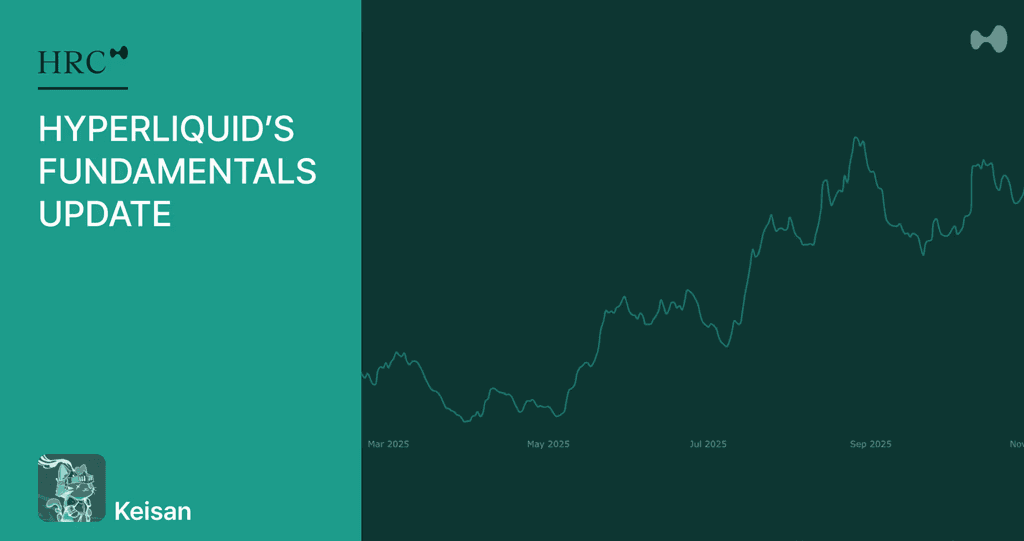
FinancialsHyperliquid’s Fundamentals UpdateDaily active users (DAUs) are one of the most important metrics to track for any software / fintech company.Hyperliquid DAUs? Up and to the right.Keisan·Nov 21, 2025
EcosystemDATs, HyperliquidEvery market eventually institutionalizes. In equities, it happened through holding companies; in credit, through securitization. In crypto, DATs stands out as one emerging pathway.Four Pillars·Nov 20, 2025
FinancialsHYPE: The Alignment VehicleIn this piece, I’ll walk through my thesis on why HYPE has quickly emerged as the dominant asset for both social and economic coordination among crypto assets and why the majority of my PA has remained in HYPE since launch.Charlie.hl·Nov 18, 2025
EcosystemAnnouncing HRC - The Research Hub for HyperliquidHyperliquid Research Collective (HRC) is an initiative by GLC Research and Four Pillars, two independent crypto research firms focused on producing unbiased, high-integrity analysis. Independence has always been our anchor.GLC Research·Nov 8, 2025
HyperliquidExchange Networks vs EmpiresHyperliquid captures value through network effects of staked HYPE, builder incentives, and composable markets.Four Pillars·Oct 23, 2025
FinancialsArete Capital Hyperliquid 2026 Thesis: Housing The Entirety Of FinanceHyperliquid has taken the digital asset space by storm in 2024/25, finally validating the long-awaited seismic move away from centralised incumbents towards a fully permissionless, transparent and global perpetual futures market. In a short period, Hyperliquid has become the No. 1 revenue-generating blockchain, dominating other generalised networks, all built and capitalised by an 11-person team. Despite Hyperliquid’s success, we believe it’s prudent to take a step back and reevaluate the thesis from the ground up, along with a concrete valuation framework.McKenna·Oct 14, 2025
Ecosystem“Liminal’s Future: Think Bigger”Liminal’s xTokens bring delta-neutral yield strategies to Hyperliquid, turning them into liquid and composable assets. Discover how Hyperliquid, Liminal, Unit and Kinetiq with HIP-3 could reshape the future of (onchain) finance.GLC Research·Oct 8, 2025
HyperliquidHyperliquid Under SiegeThe real test is not whether you avoid this failure, because you won’t.Four Pillars·Sep 30, 2025
EcosystemHyperliquid Strategies Interview – “Rethinking Financial Rails” by Forward GuidanceGLC Research·Sep 24, 2025
FinancialsWhy Hyperliquid ($HYPE) is so cheap? – “The Token Risk Premium”$HYPE trades at ~9x FCF despite $1.3B in annualized revenue, mainly due to token-specific risk, limited access, and market mispricing.GLC Research·Sep 16, 2025
Trade[XYZ] & RWA PerpetualsWhy HIP-3?For investors, HIP-3 expands into traditional markets and enables entirely new ones.Four Pillars·Sep 15, 2025
FinancialsHyperliquid Fee Growth – “YTD Performance”Hyperliquid is rapidly becoming one of the most remarkable growth stories in crypto.Keisan·Sep 4, 2025
EcosystemWhy HYPE DATs Can WinOver the past couple months, I’ve been exploring the DAT space and what it could mean (or not mean) for DeFi and particularly credit opportunities on-chain.Charlie.hl·Sep 4, 2025
FinancialsIs Hyperliquid Undervalued? “The Valuation Gap: $HYPE vs. Robinhood, Coinbase, and Nasdaq”Hyperliquid has established itself as one of the fastest-growing companies in the spaceGLC Research·Sep 2, 2025
FinancialsHyperliquid: “The path to $1,000 $HYPE”I’ve written a lot about $HYPE’s value today, but what about its value in 5-years?Keisan·Aug 25, 2025
EcosystemHyperliquid Strategies (DAT) Interview: “Making Hyperliquid a Wall Street Asset”Yesterday, we joined a call hosted by Keisan and Monk with Bob Diamond and David Schamis, the founders of Hyperliquid Strategies, a firm with a singular objective: maximizing Hype per share.GLC Research·Aug 23, 2025
FinancialsHyperliquid S1 Report: “Inside Hyperliquid’s Growth”Welcome to this Hyperliquid Semiannual Report,GLC Research·Aug 14, 2025
EcosystemIntroducing Pendle Citadel:“HyperEVM integration”As more yield-bearing assets emerge on HyperEVM, this integration gives users powerful tools to speculate on, hedge, or enhance their yield, a major step toward a more composable and sophisticated DeFi landscape on Hyperliquid.GLC Research·Aug 8, 2025
Trade[XYZ] & RWA PerpetualsHIP-3: “Hyperliquid’s X-Factor”HIP-3’s potential and what it means for Hyperliquid, as well as crypto as a whole.Keisan·Aug 5, 2025
FinancialsHyperliquid’s Valuation Framework ($HYPE)It has been about 6 months since I initially posted my valuation framework for $HYPE. A lot has changed since then, but also much has remained true. I am as bullish on $HYPE as I have ever been.Keisan·Jul 28, 2025
EcosystemHyperliquid Is Great, But Have You Ever Tried HyperEVM?The HyperEVM + HyperCore dual-engine setup lets Solidity contracts pull live order data or inject trades instantly, enabling lending, options, structured products, and more.Four Pillars·May 20, 2025
Financials$HYPErsound MoneyHyperliquid unifies all core network actions (listings, trading fees, bonding, staking, etc) into one token ($HYPE), locking in scarcity, real utility, and yield under a single asset.Four Pillars·May 9, 2025
FinancialsHyperliquid Valuation Thesis: “The House of Finance”Hyperliquid leads DEX perps with $600M+ in revenue, 97% buybacks, and a custom Layer 1. Explore $HYPE token valuation and risk/reward scenarios.GLC Research·Mar 19, 2025
HyperliquidHyperliquid vs. CEXs: “Trade War 2.0 – The JELLY Incident”A $JELLY exploit pushed Hyperliquid to the edge. CEX listings escalated the attack. Centralized intervention worked but it raised some questions.GLC Research·Mar 19, 2025
HyperliquidHyperUnit Overview:“Bridging CEX Experience Onchain”Discover how Hyperliquid and Unit merge CEX performance with DEX composability. Metrics, fees, liquidity, and adoption analysis inside.GLC Research·Mar 19, 2025
RegulationHPC and Multicoin Back the CFTC's Prediction Markets FrameworkAmericans taking to the markets to express their views on major events is nothing new. For decades before political polling existed, Americans were able to trade openly on organized markets for presidential races in the United States, and they enjoyed prices that were widely regarded as the most accurate election forecasts of their day. These markets allow Americans to trade on everything from Federal Reserve rate decisions to election outcomes, and the financial industry has noticed: major exchanges and Wall Street trading firms are moving into the space.Hyperliquid Policy Center·Jul 28, 2026

 Hyperliquid Policy Center·Aug 21, 2026
 GLC Research·Aug 20, 2026
 Hyperliquid Policy Center·Aug 18, 2026
 Hyperliquid Policy Center·Aug 17, 2026


![HPC and trade[XYZ] Ask the CFTC to Bring Energy Perpetual Contracts to U.S. Markets](/_next/image?url=https%3A%2F%2Fokcjmvpzoviticlqzawe.supabase.co%2Fstorage%2Fv1%2Fobject%2Fpublic%2Fassets%2Fimg%2Fblog%2F1787753927432687088.png&w=3840&q=75)