
Attention goes wherever the volatility is: oil in Q2, memory chips in Q3, Nvidia this week. Hyperliquid adapts to each rotation, and when Nvidia's news broke outside Nasdaq hours, it was one of the few venues pricing it live.
Data as of 10:22 AM ET, November 12, 2026.
Key takeaways
- Attention rotates, the venue stays open. trade[XYZ]'s largest market was oil in Q2 2026, a memory-chip stock in Q3 and, this week, Nvidia.
- Nvidia broke three times outside the session. On Sunday, with every US venue closed, on Wednesday after the closing bell, and on Thursday morning before it, xyz:NVDA repriced within minutes. In the 55 minutes after Wednesday's news, it traded more than in its entire Nasdaq session that day.
- The price held up. On Sunday, with only Hyperliquid's own order book open, xyz:NVDA moved 41.1% of the way to Monday's opening price before other markets reopened. On weekdays it follows pre-market prices into the open, and landed within 23 bps even after a 13.1% gap. The order book bent under the WSJ story and was back to a one-cent spread four minutes later.
- Anthropic is next. xyz:ANT trades 33.3% above the top of Anthropic's IPO range, days before the expected Nasdaq listing.
Attention never closes
Markets do not move on a schedule. Attention goes wherever the volatility is, and volatility does not wait for 9:30 AM ET.
On trade[XYZ], the largest HIP-3 deployer on Hyperliquid, that rotation shows quarter by quarter (Exhibit 1). In Q2 2026, the Strait of Hormuz closures made oil the venue's largest market. In Q3, the memory-chip trade took over and equities became the majority of volume. This week, it was one name: Nvidia. As these markets mature, liquidity can ebb in one asset class while the venue as a whole keeps growing, because another class gains ground: equities took over from commodities in Q3, and in November trade[XYZ] is averaging $4.4B a day, ahead of July, its strongest month so far.
What stays constant is the venue. trade[XYZ]'s perpetual derivatives trade 24/7, onchain, on Hyperliquid's order book. When Nvidia's news broke three times outside the Nasdaq session this week, xyz:NVDA was open for all three: alongside after-hours and pre-market trading on Wednesday and Thursday, and on Sunday as the only place the news could be priced at all.
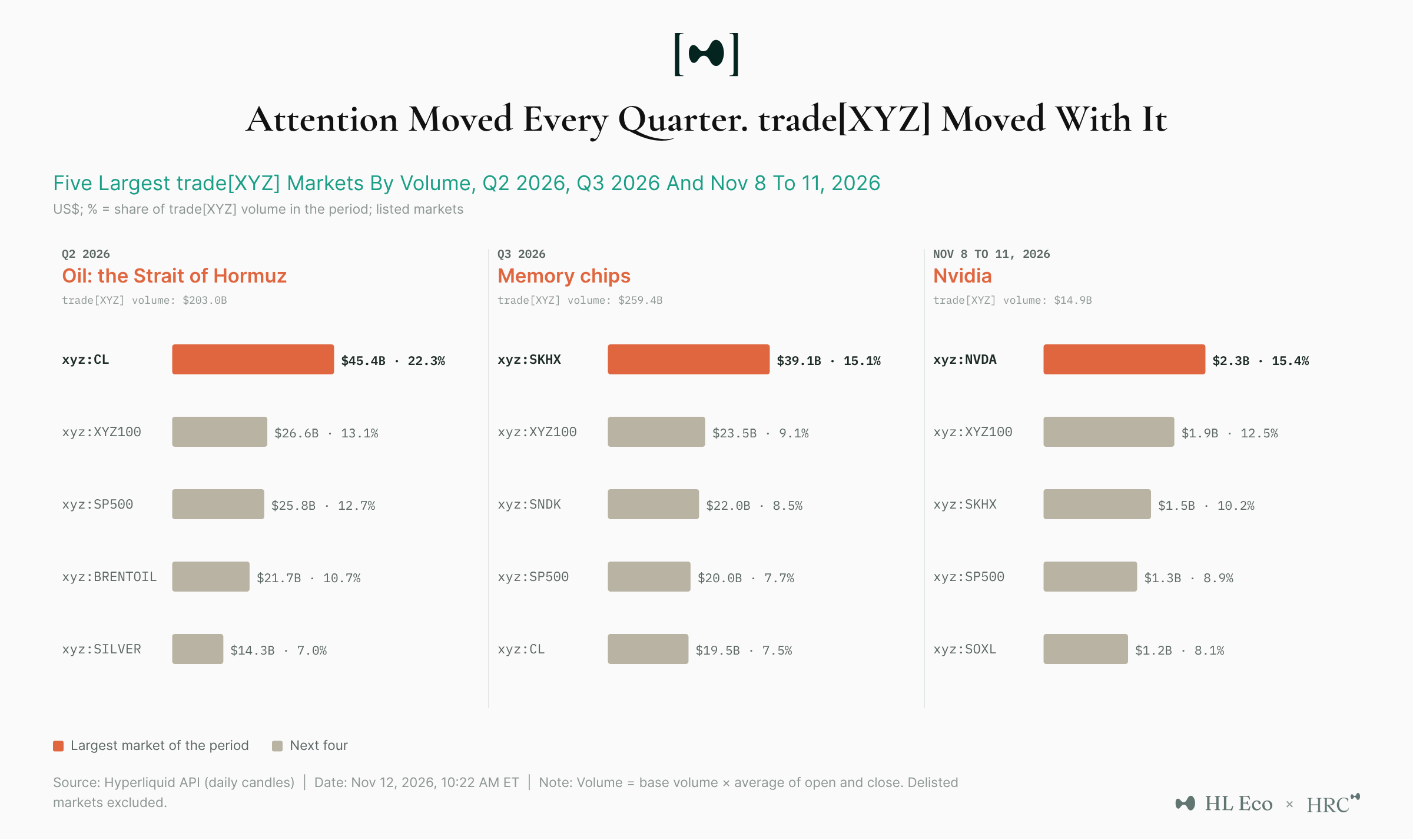
Exhibit 1. Attention moved every quarter, and trade[XYZ] moved with it. Source: Hyperliquid API. Date: November 12, 2026.
1. Nvidia broke three times outside the session
xyz:NVDA is a perpetual derivative on one Nvidia share. From Sunday 8:05 PM to Friday 8:00 PM ET, its price follows external markets, including after-hours and overnight trading. Over the weekend, Hyperliquid's own order book sets it (trade[XYZ] specification).
- Sunday, November 8, 2026. At 3:23 PM ET, Bloomberg published the board's investigation and Jensen Huang's memo. No US venue was open. Within 20 minutes, xyz:NVDA fell from about $186 to as low as $180.15. When external pricing resumed at 8:05 PM ET, it had already priced 41.1% of the gap Nasdaq would open with 13 hours later.
- Wednesday, November 11, 2026. At 4:55 PM ET, the New York Times reported a second alleged affair; at 5:28 PM ET, the Wall Street Journal reported that the board was preparing to oust Huang. xyz:NVDA fell from $174.68 to $168.53 within five minutes of the first story and printed $156.14 after the second, 10.1% below the Nasdaq close.
- Thursday, November 12, 2026. Nvidia announced that Huang had resigned as CEO, president and director, effective immediately, with CFO Colette Kress as interim CEO (Nvidia). US pre-market trading was open and xyz:NVDA moved with it: the 8:48 AM ET minute traded $26.5M, the price fell from $159.17 to $154.27 within six minutes, and $112M traded in the first eight. At the 9:30 AM ET open, Nvidia printed $150.99, 13.1% below Wednesday's close. By 10:22 AM ET, xyz:NVDA had rebounded to $164.60.
Traders came when the market was supposed to be shut. $331M traded in the 55 minutes after the Wednesday news, more than xyz:NVDA did across the full 6.5-hour Nasdaq session that day ($227M). The hour of the WSJ story traded 95x a normal off-hours hour, and from Friday's close to Thursday's open, 67.6% of xyz:NVDA's $3.0B of volume traded outside the Nasdaq regular session (Exhibit 2).
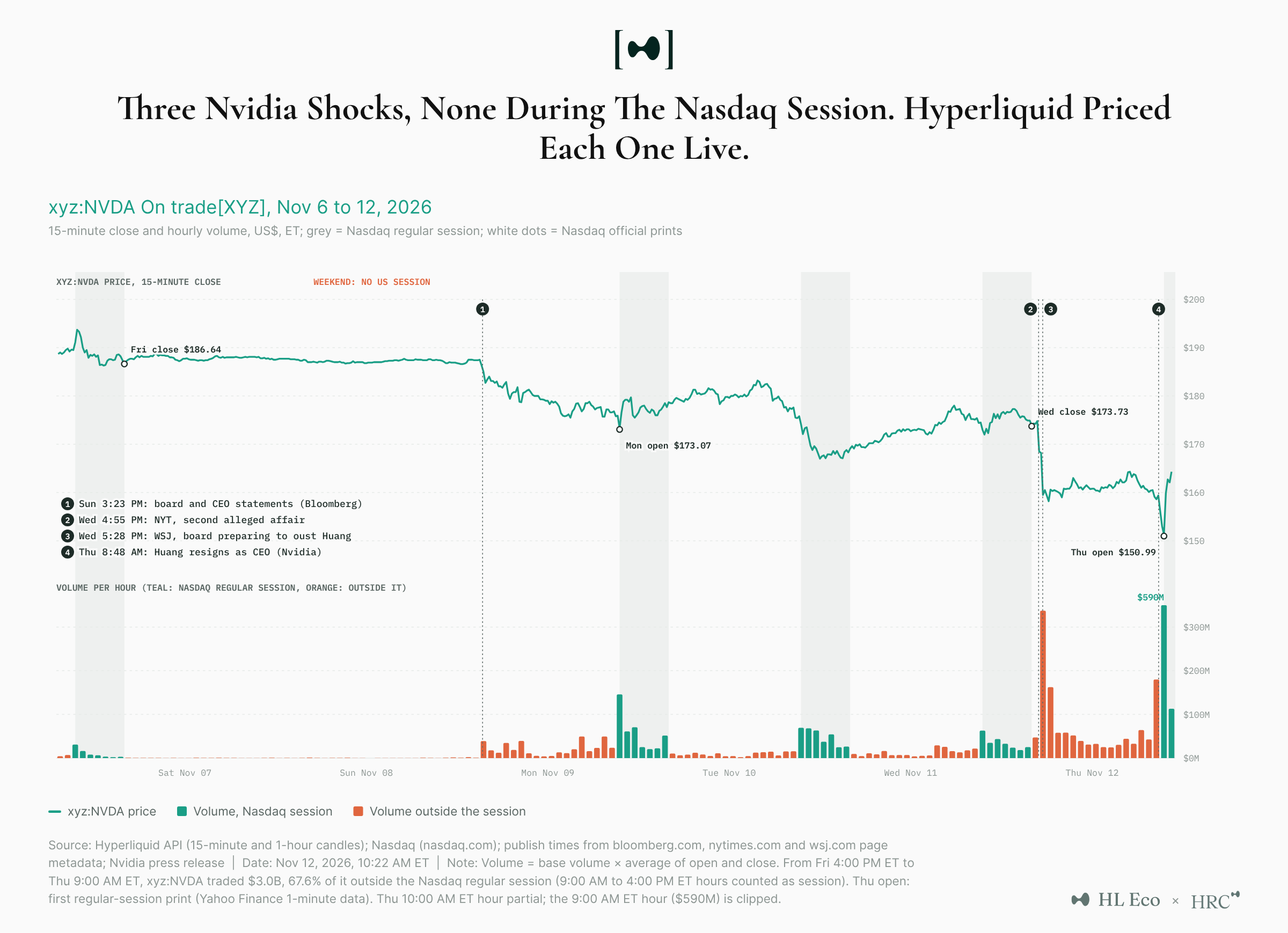
Exhibit 2. All three Nvidia shocks broke outside the Nasdaq session, and Hyperliquid priced each one live. Source: Hyperliquid API, Nasdaq, Yahoo Finance, Bloomberg, NYT, WSJ, Nvidia. Date: November 12, 2026.
At 10:22 AM ET on Thursday, xyz:NVDA was Hyperliquid's second-largest market by 24-hour volume ($2.1B, behind only BTC and ahead of ETH) and fourth by open interest ($604M): the largest HIP-3 market on both measures (Exhibit 3).
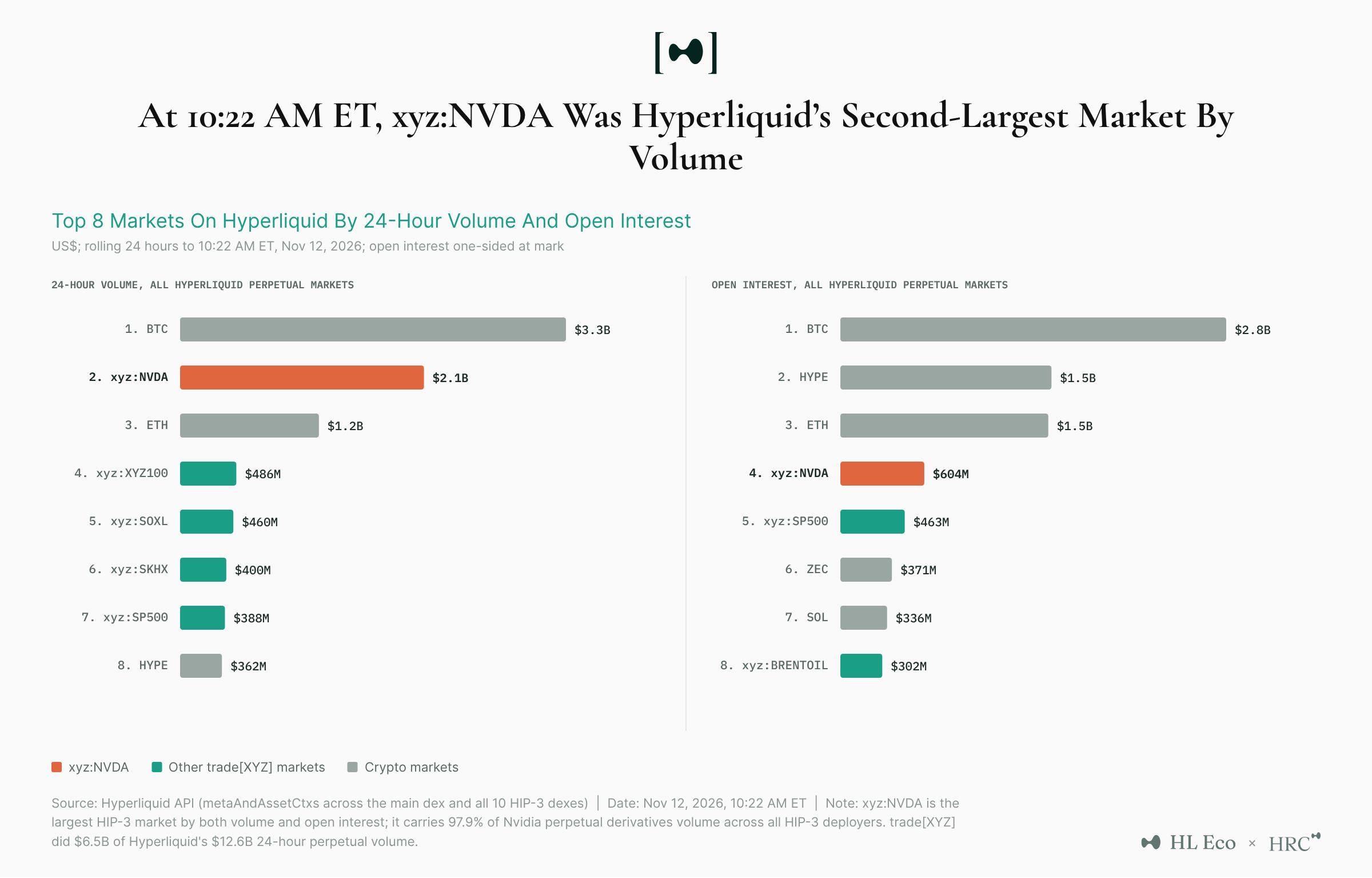
Exhibit 3. At 10:22 AM ET, xyz:NVDA was Hyperliquid's second-largest market by 24-hour volume, behind only BTC. Source: Hyperliquid API. Date: November 12, 2026.
2. Was the price right?
Access only matters if the price is right. We checked it two ways.
- Against the open. At the bell, a close match is by design. From Sunday 8:05 PM to Friday 8:00 PM ET, xyz:NVDA follows external markets, including pre-market trading (specification), so it should land on Nasdaq's official open, and it did: 12 bps away on Monday, 9 bps on Tuesday and Wednesday, and 23 bps on Thursday, after a 13.1% gap. When Huang resigned, it moved in the same minute as Nvidia's pre-market trades, and the hand-off at the bell was seamless: $151.33 at 9:29 AM ET, $151.34 as Nasdaq opened. The more telling part is what happened before the bell (Exhibit 4). On Sunday, with no other venue open, Hyperliquid's own order book had moved xyz:NVDA 41.1% of the way to Monday's opening price by 8:05 PM ET, when external prices returned and took it further. On Wednesday night, it priced 63.0% of Thursday's gap within an hour of the WSJ story, 15 hours before Nvidia announced Huang's resignation. Both times the price moved toward where Nasdaq would open, without overshooting it.
- Against the shock. Order book data from Hydromancer shows the WSJ story stretched the book without breaking it. Before the news (4:00 to 4:55 PM ET), the spread was one cent in 85.5% of minutes. At 5:28:54 PM ET, a block of sell orders, including liquidations, swept the book to $156.00 and the spread widened to $0.19. Four minutes later it was back to one cent, and by the 6:00 PM ET hour, depth near the price was back close to its pre-news level (Exhibit 5).
Why it matters. A price that follows external markets is only useful if it holds up when those markets are thin or shut. This week xyz:NVDA tracked them into the open, moved in the right direction while they were closed, and stayed liquid enough to trade. That said, the book is thinner when Nasdaq is closed, with about $850K across the 20 visible price levels, compared with $3.0M during the regular session.
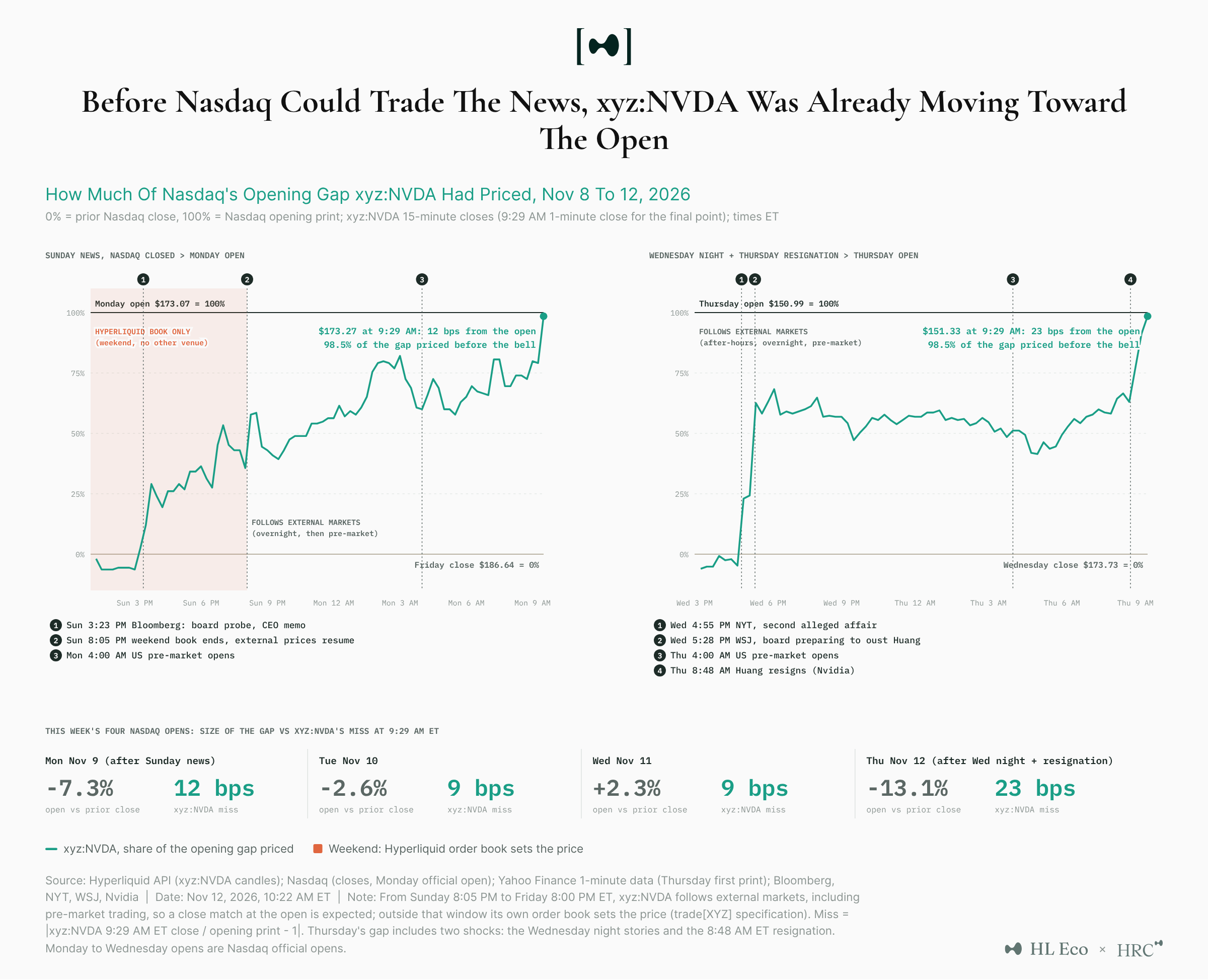
Exhibit 4. Before Nasdaq could trade the news, xyz:NVDA was already moving toward the open; on Sunday, its own order book set the price. Source: Hyperliquid API, Nasdaq, Yahoo Finance, Bloomberg, NYT, WSJ, Nvidia, trade[XYZ]. Date: November 12, 2026.
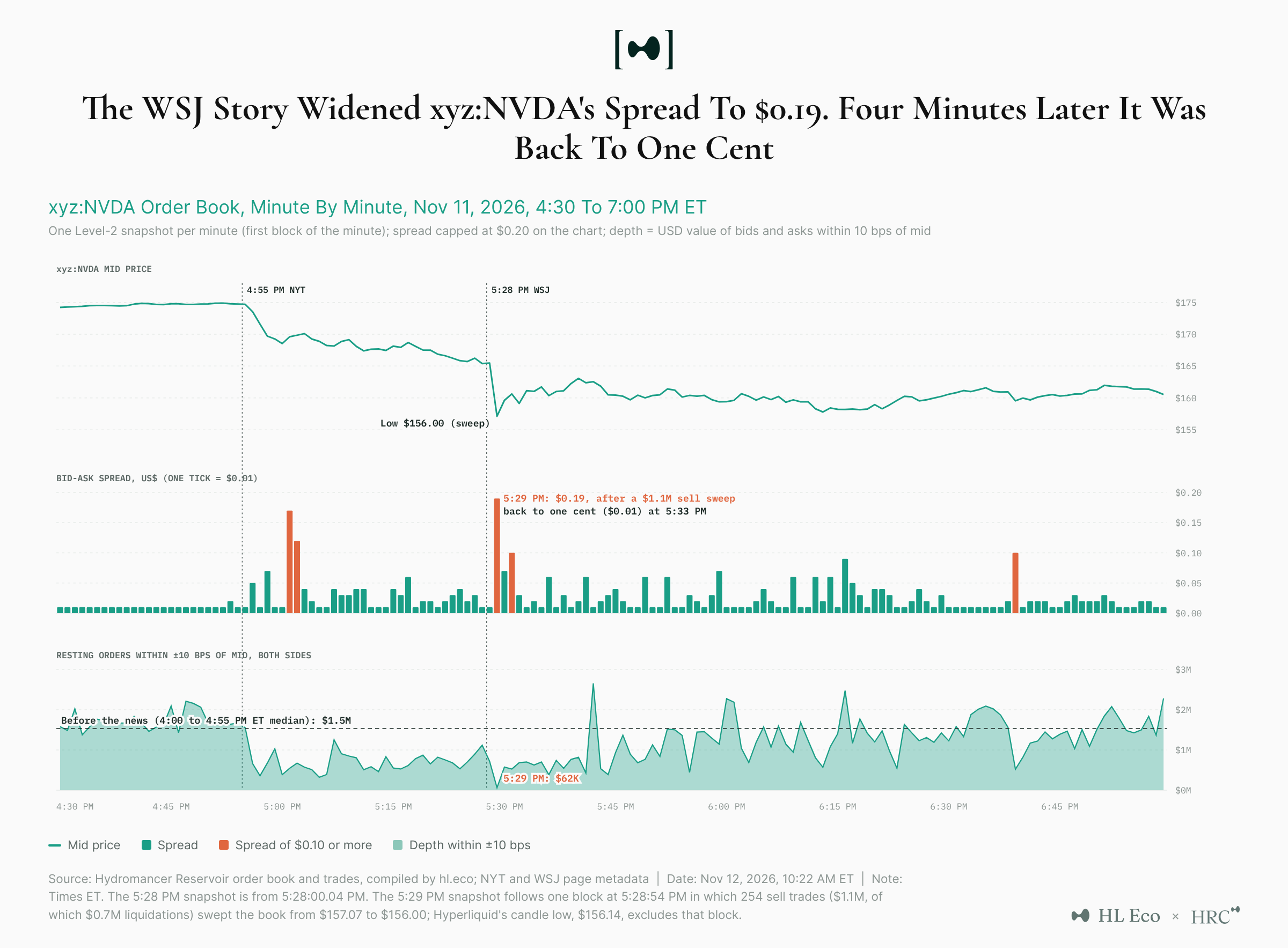
Exhibit 5. The WSJ story widened xyz:NVDA's spread to $0.19; four minutes later it was back to one cent. Source: Hydromancer Reservoir order book and trades, compiled by hl.eco. Date: November 12, 2026.
3. Next: pricing an IPO before it lists
The next rotation is already trading. xyz:ANT, the pre-IPO contract on Anthropic, listed on October 26, 2026 at $138.00. On November 10, 2026, Anthropic filed an IPO range of $70 to $78 a share, valuing it at up to $1.4T, with Nasdaq trading as early as November 18 or 19 (Fortune).
xyz:ANT traded $110M on filing day, its busiest day, and dipped to $90.37 before recovering. At 10:22 AM ET on Thursday it traded at $103.95, 33.3% above the top of the range, with $108M of open interest. David Schamis, CEO of Hyperliquid Strategies, put it plainly: "The 'IPO Pop' is alive and well." If Anthropic opens near where xyz:ANT trades, the range was set below where buyers were already clearing, and Hyperliquid will have priced the pop before the first Nasdaq trade (Exhibit 6).
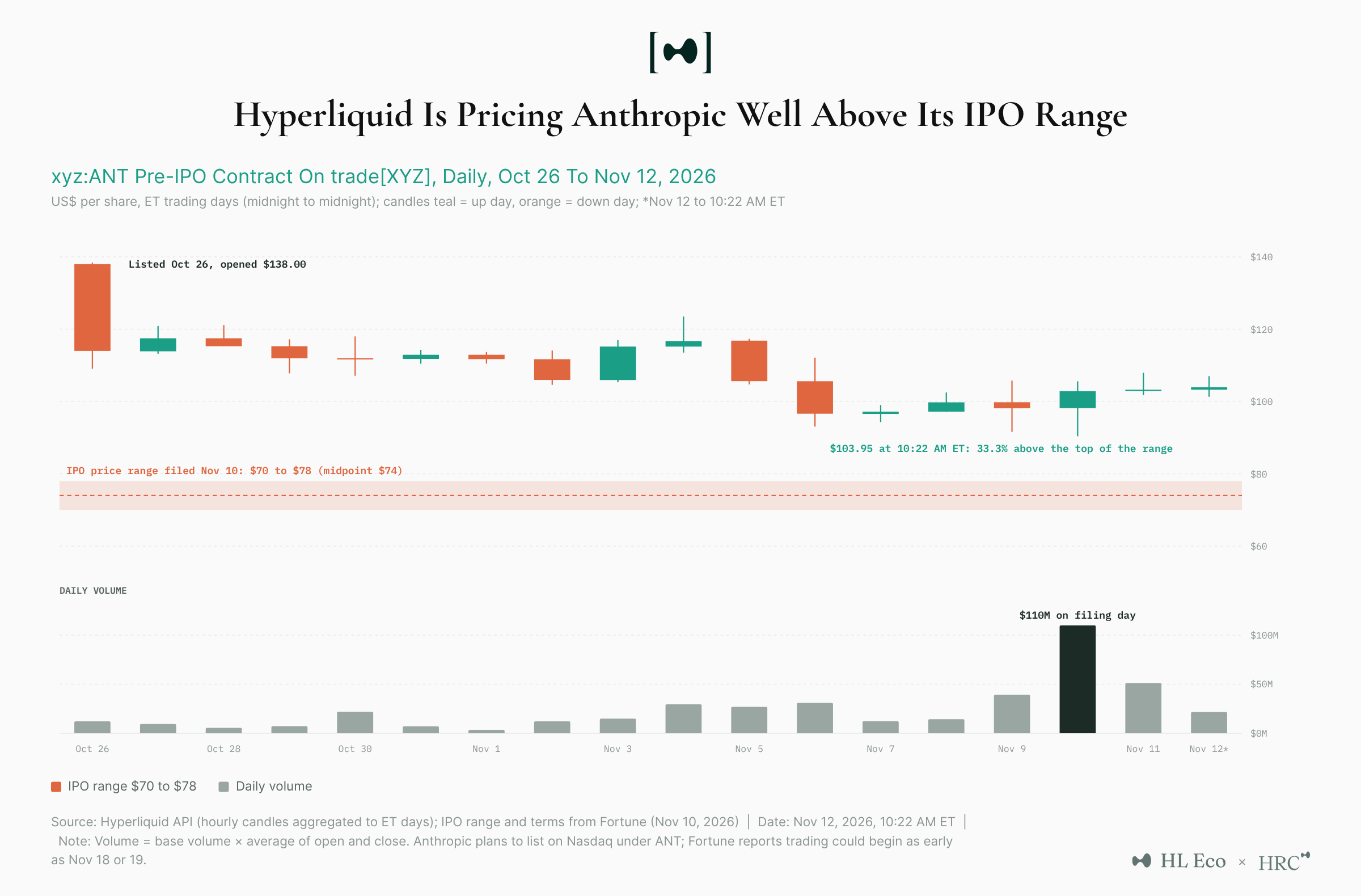
Exhibit 6. Hyperliquid is pricing Anthropic well above its IPO range. Source: Hyperliquid API, Fortune. Date: November 12, 2026.
What we are watching
- Nvidia's next CEO. The board is searching for a permanent CEO, with CFO Colette Kress serving as interim CEO (Nvidia). Nvidia reports its Q3 fiscal 2027 results on November 17, 2026, after the Nasdaq close: one more print outside the session.
- Anthropic's first print. We will compare it with xyz:ANT's last price.
- November. trade[XYZ] averaged $4.4B a day from November 1 to 11, ahead of July, its strongest month so far.
Where the valuation stands
The week's news landed on a stock that was already falling. At 10:22 AM ET on Thursday, Nvidia traded at $164.31, 27.4% below its October 12, 2026 close of $226.32. Consensus earnings have not moved with the price: on Yahoo Finance estimates, Nvidia trades at 11.3x next-12-month earnings, compared with a median of 24.5x for AMD, Broadcom, Marvell, Qualcomm and Intel, the chipmakers Nvidia names as competitors in its 10-K. That is the lowest forward multiple in the group (Exhibit 7). Most of those estimates predate this week, so the gap is either a discount for the governance turmoil or a sign that estimates have further to fall. Nvidia's fiscal Q3 2027 results on November 17, 2026 will be a first test.
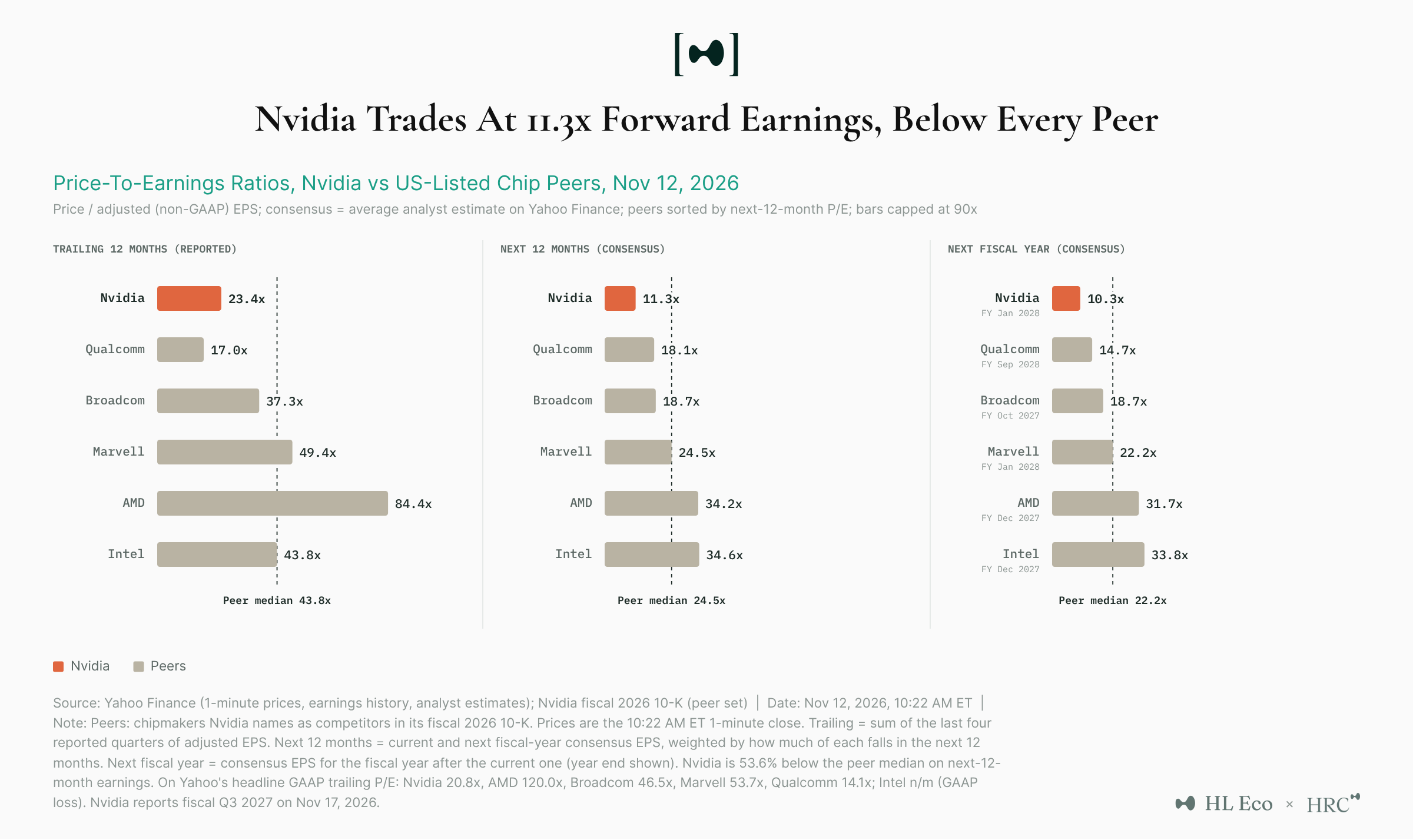
Exhibit 7. Nvidia trades at 11.3x forward earnings, below every peer. Source: Yahoo Finance, Nvidia 10-K. Date: November 12, 2026.
Final thoughts
In our Q2 2026 trade[XYZ] report, Collins from trade[XYZ] described where this is going: "I think the approach has to shift from crypto assets to just assets people want to trade 24/7." This week put that idea to the test on one of the most valuable companies in the world.
Attention moves between markets and asset classes: oil in Q2, memory chips in Q3, Nvidia this week, Anthropic next. That makes a multi-asset venue partly countercyclical: when flows leave one asset class, another can take their place, so a quiet market does not mean a quiet venue. Hyperliquid does not need to predict where attention goes. Wherever it goes, trade[XYZ] can list it as a perpetual derivative, and it trades 24/7 on Hyperliquid's order book when the attention arrives.
In five days, Nvidia faced a board investigation, two newspaper reports and its CEO's resignation, and every one of them broke outside the Nasdaq session. Hyperliquid was one of the few venues where traders could act on that news as it broke, whether to take a view or to hedge an existing position, and xyz:NVDA priced each shock in real time: on Sunday with no other venue open, and on Wednesday night and Thursday morning alongside after-hours and pre-market trading.
That is what access means here: a market that is open when the news is, with every order and fill visible onchain. In Collins's words, it is "no longer this crypto versus TradFi, but how finance in general evolved."
Wall Street keeps hours. News doesn't.
Hyperliquid.
Methodology. Volumes use Hyperliquid's public API candles (base volume × average of open and close), which give $259.4B for trade[XYZ] in Q3 2026, compared with $259.2B on hl.eco; hourly multiples and weekly totals use the same method. Event-window volumes and order book figures come from Hydromancer's Reservoir, compiled by hl.eco: one Level-2 snapshot per minute, 20 price levels per side, and every trade. Nasdaq closes and the Monday to Wednesday opens are official prints; Thursday's opening price is the first regular-session print in Yahoo Finance's 1-minute data, pending Nasdaq's official open. Valuation multiples (Exhibit 7) use Yahoo Finance prices and consensus estimates on adjusted EPS. Event times are the publishers' own timestamps. All times are ET, and daily figures use ET days (midnight to midnight). Opening comparisons use 9:29 AM ET prices; volume, open interest, rankings and current prices are as of 10:22 AM ET, November 12, 2026.
This is not financial advice.
Sources: Bloomberg (November 8, 2026), CNN (November 8, 2026), The New York Times (November 11, 2026), The Wall Street Journal (November 11, 2026), Nvidia investor relations (November 8, 2026), Fortune (November 10, 2026), Nvidia press release (November 12, 2026), Nasdaq, Hyperliquid API, Hydromancer Reservoir, hl.eco, trade[XYZ] Q2 2026 report (HRC), Yahoo Finance, Nvidia 10-K (February 25, 2026).