We spent a lot of time these past months analysing liquidity on all DEXs for all kind of instruments because of the redacted product we released. We have more than a year and a half of full orderbook data since we traded those markets with 0d Labs, and we observed a very unexpected phenomenon on the whole long-tail surface of crypto: liquidity is getting thinner and thinner. We would have expected such a result before and after 10/10, but it seems that the crypto market as a whole didn't really recover from this.
On top of that, we recently witnessed a lot of complaints from close trader friends about Hyperliquid getting harder and harder to compete on because of dynamics centralizing the winners: from read priority fees being monopolized by Wintermute, to fees and L1 congestion being a nightmare for small MMs. So I decided to dive a bit deeper on Hyperliquid's liquidity dynamics, and try to understand if we witness a causality between things getting harder for small shops and liquidity on the platform, where arguably listing long-tail assets with deep liquidity was the moat of HL early on.
Building a benchmark first
First thing we need here is a benchmark against the overall crypto market: liquidity can get thinner, but if it's a global phenomenon, we need to be able to differentiate what's global and what's isolated. The useful benchmark for global altcoin liquidity is Binance. We construct for this benchmark a universe of 86 assets that are traded on both venues, and that offer less than 10x leverage from 1st November 2025 to 1st November 2026: that's our long tail echantillon.
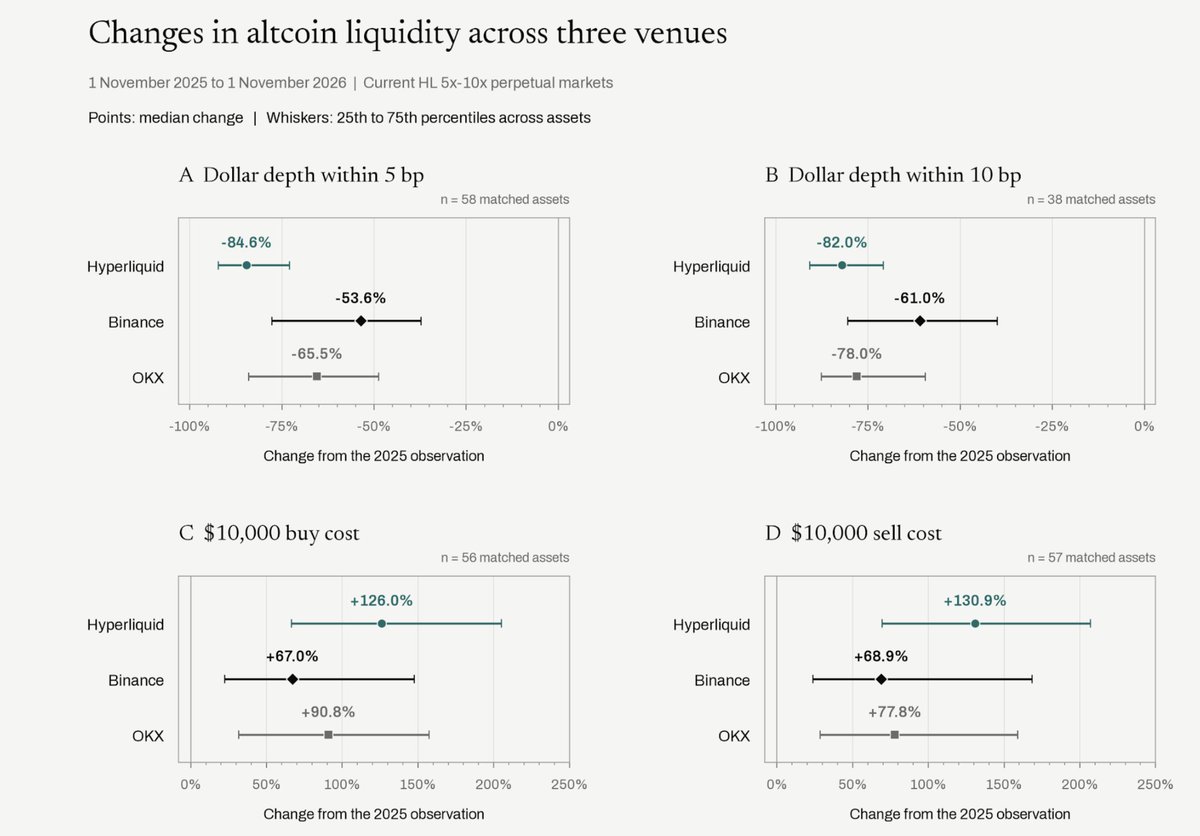
On the 38 markets we can compare at 10 bps, we get a median decline in dollar depth of 82% on HL, against 61% on Binance and 78% on OKX. That's already pretty significant. Of course the tokens getting cheaper explains part of what we lose in dollars, but we also need to check whether we have fewer tokens quoted at those prices.
To see how much of this was specific to HL, I divided HL depth by Binance depth for each asset and compared that ratio a year apart. At five bps, its median decline was 57.5%. So even when we look at the same token on the two venues, HL loses a lot of liquidity relative to Binance. We calculate those ratios market by market, we don't just divide the two venue medians.
If we want to buy $10,000 in the later sample, the median cost from the displayed book is 5.21 bp on HL against 2.95 bp on Binance, before fees. That's $5.21 versus $2.95 on a fairly small order.
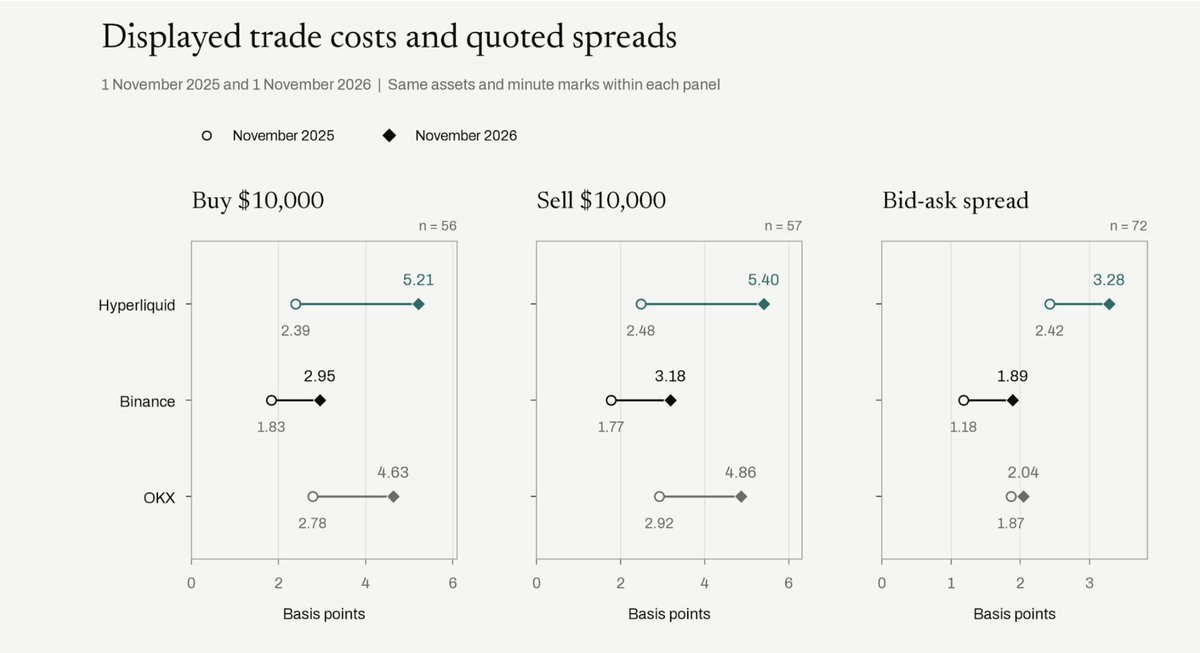
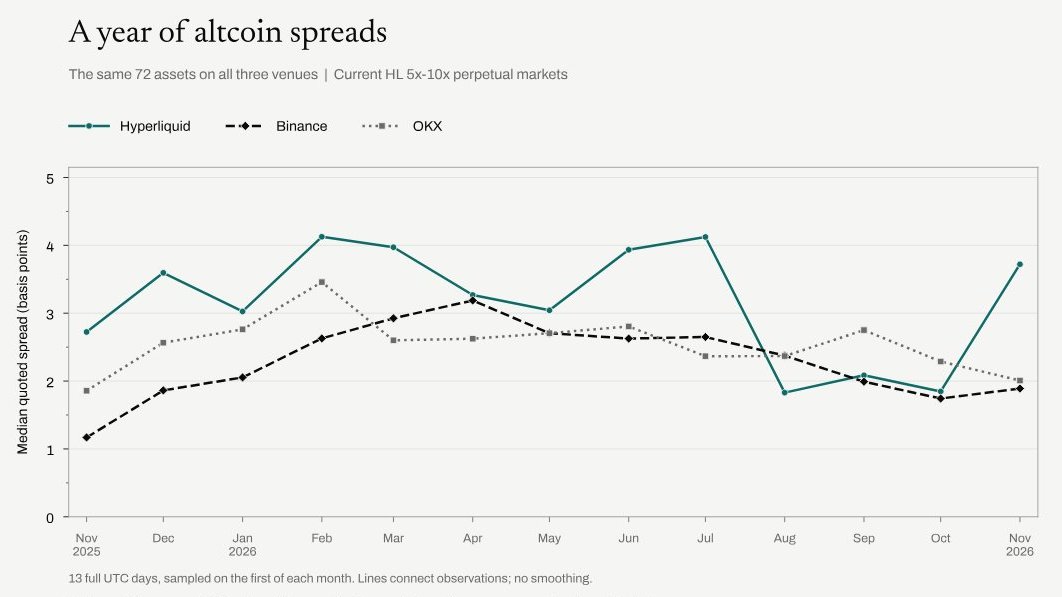
Spreads are a useful counterexample. They widened a bit more in proportion on Binance (still from a tighter starting level, and ending tighter too).
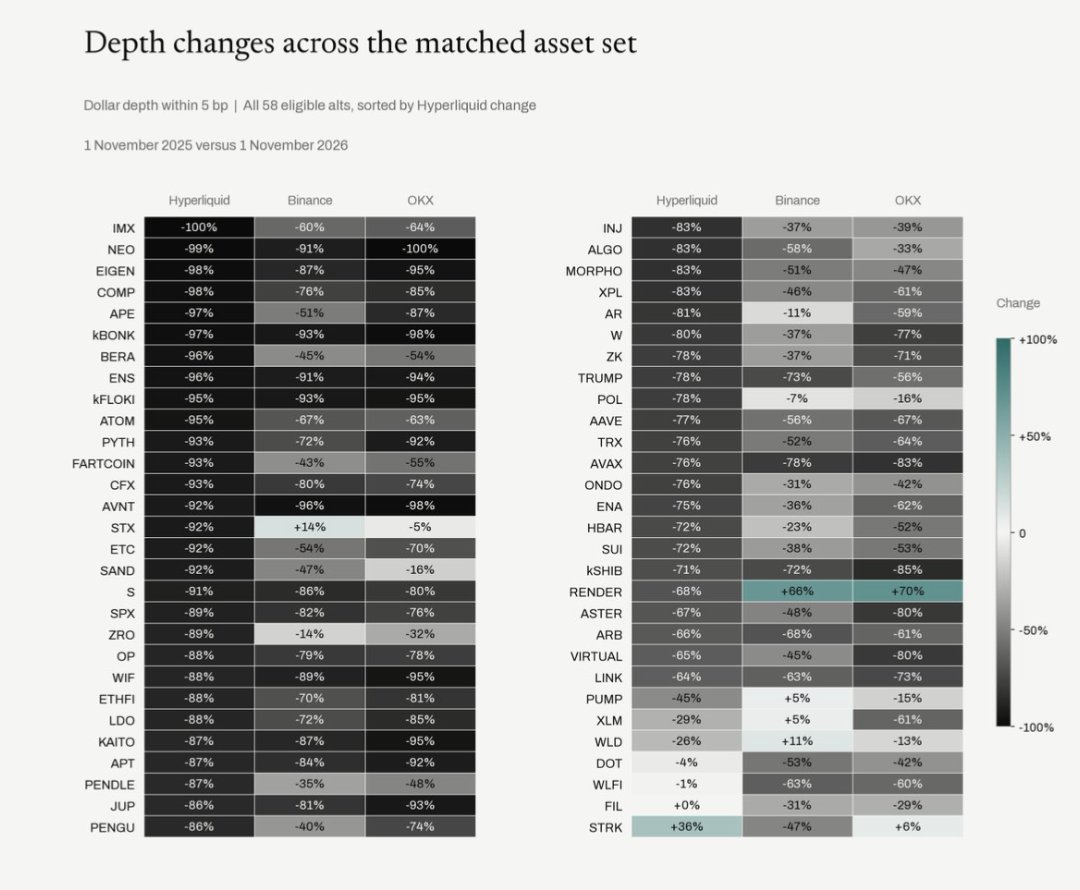
The problem is clearest near the midpoint
A basic critic of the model could say that a token dumping could artificially make an unchanged pile of tokens look like a shrinking book. To separate those effects, we track both quoted dollars and token quantities.
The HL chart holds the assets and observation hours fixed across 13 sampled dates. The five-basis-point panel contains 63 markets, the broader top-20 panel contains 80. Beware that those are stricter samples than a two-date comparison, so their endpoint figures should not be substituted for the CEX comparison above.
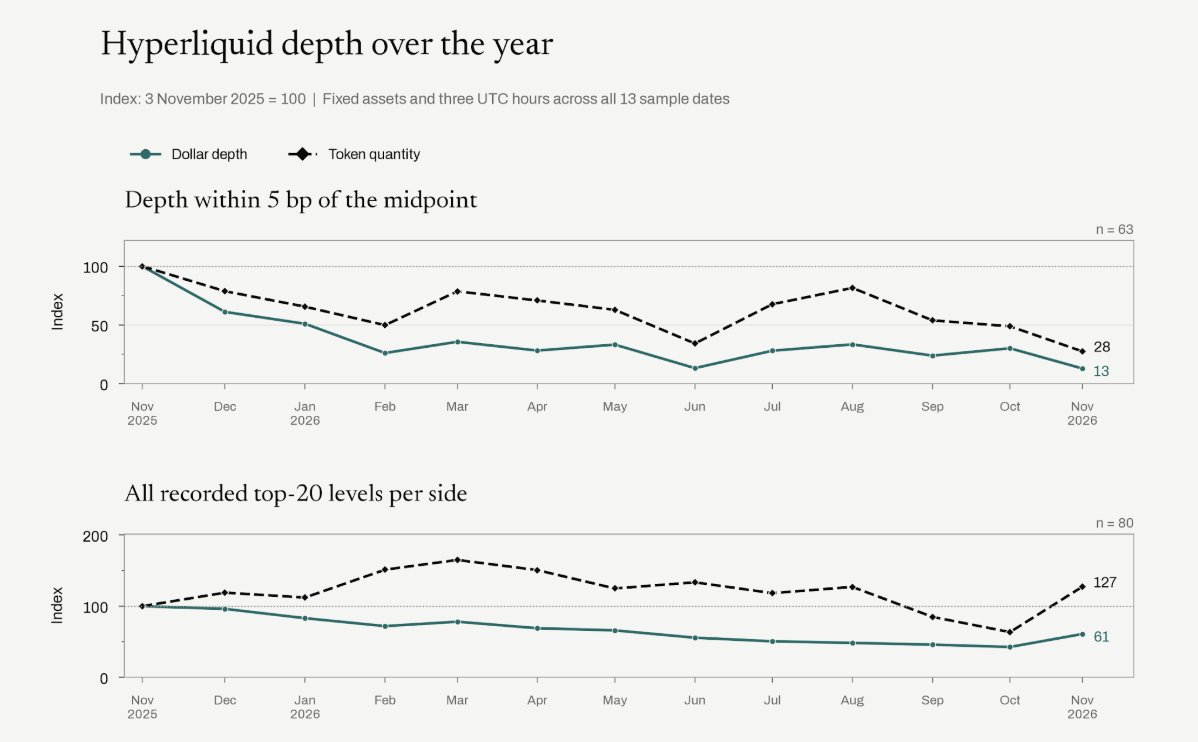
We set each market to 100 in November 2025 to make this easier to follow. A year later, at five bps we end up around 13 in dollars and 28 in tokens, taking the median across markets. So even after removing the price effect, we have lost most of the quantity that used to be quoted there.
If we go further out and count all 20 recorded levels, the median indices end at 61 in dollars and 127 in tokens. That's quite a different picture: the typical market in this wider sample has more tokens quoted than before, while our five-bps sample has much less. There is size in those books, but a lot less of it where we would want to trade.
A bit more of granularity
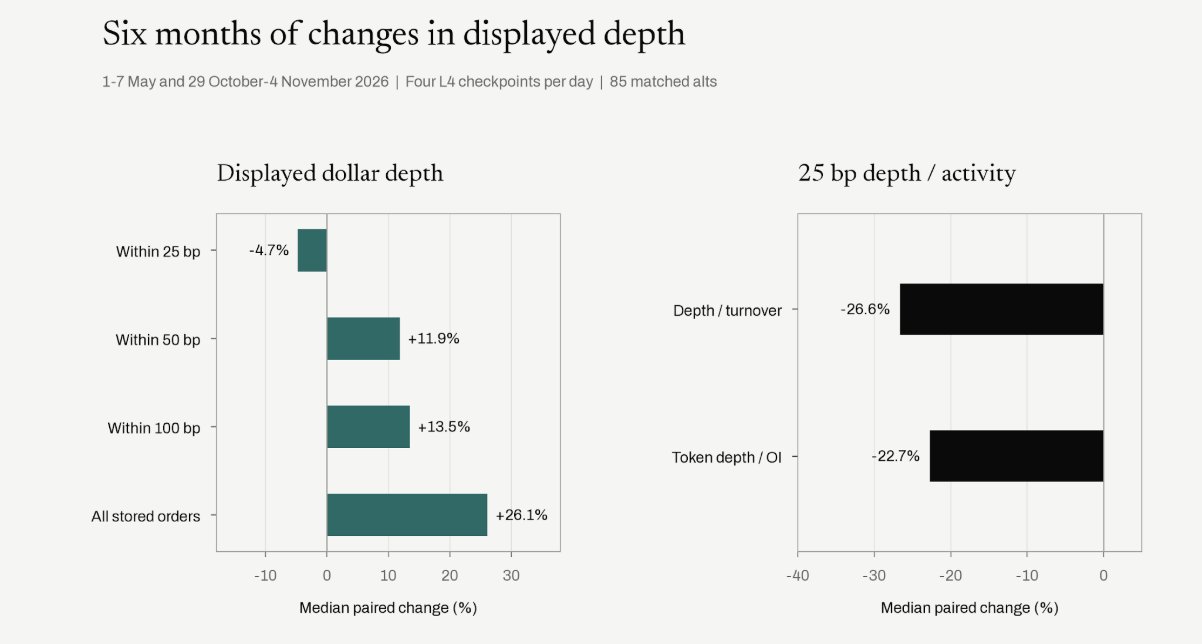
It seems like a good idea to give the 6 months picture, that saw depth improving (not near the touch, but wider depth overall).
Now if we try to have a bit more of granularity, let's look at a year of spreads. And here, surprise, we see that spreads on HL were catching up with the rest of the cohort, up until recently. Obviously we'll have to wait a bit before confirming this as a trend and not just an exception, but what we observe here in the books coincides well with the recent problems we described earlier with recent centralization of the market structure.
Is competition getting thinner?
So I went back to the underlying account structure and grouped master accounts with their explicitly linked subaccounts, so I wouldn't count the same account family several times. It allows us to identify those account families, even if we don't know which firm they're coming from.
I had thought we had a couple of big makers taking most of the volume but the year-on-year execution numbers don't match that. When I compared a full week a year ago with a full week recently across the same 80 markets, we see that the median share of the maker volume that was executed by the largest account family shrank from 25.2% to 14.6%. So I wouldn't say that you can explain that whole year of decline by one shop doing it all. But the other thing that we're interested in is what happened to the quotes very recently.
Now let's zoom in on the last month, using the same 72 assets as our spread benchmark. Here, the timing is quite striking: from around October 30, spreads widen as liquidity close to the price becomes more concentrated. Comparing October 8 to 14 with October 31 to November 6, the median share held by each market's largest account group within 25 bps rises from 34.5% to 38.6%, while the median quoted spread goes from 2.13 to 3.55 bps. This is much closer to what the MMs were complaining about. We still have Binance's October 29 security incident in the middle of that window though, so I wouldn't attribute this move specifically to priority fees or congestion from these curves alone.
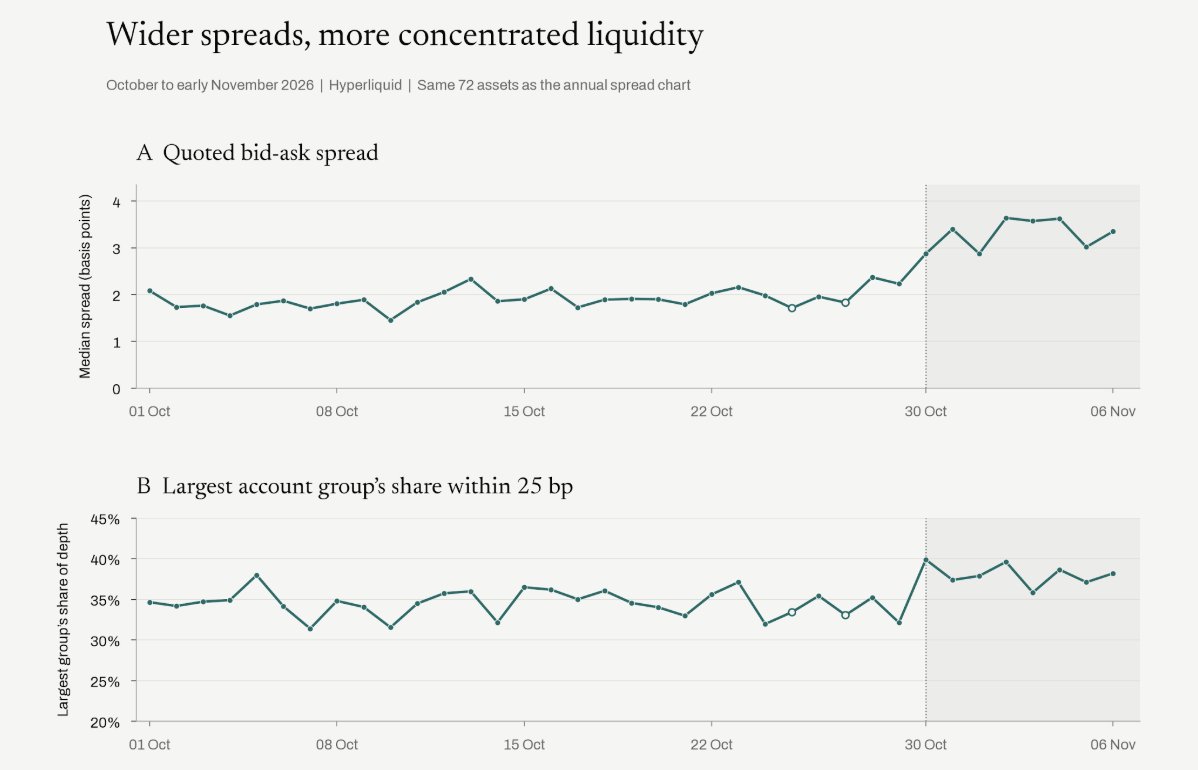
Looking at the accounts individually, we also see one large supplier cutting its quotes sharply around November 3, with several other families gaining share. So this might be an explanation too, time will tell.
The fee structure
There is also a pretty basic problem with fees here. We looked at the historical maker fees paid by 54 account families: the lowest-volume quartile paid 0.961 bp, while the highest-volume quartile received 0.236 bp in rebates, using volume-weighted rates. For a smaller-volume maker, that is roughly 1.20 bp to make up before we even start talking about hedging or bad fills. On a spread of a few bps, this is a lot to give away. There's a structural disadvantage for the smaller makers.
We can also see participation thinning in the quotes themselves. Across the same 72 markets, comparing October 8-14 with October 31-November 6, the median market's average count of account families quoting at least $1,000 on each side within 25 bps dropped from 7.64 to 6.39. Even with token prices held constant, that count still dropped in 58 of the 72 markets. There are fewer account families providing meaningful quotes close to the price, even after discounting the token sell-off.
HIP-4 needs smaller makers too
Congestion is another challenge. HL's congestion rules are currently based on an address's weighted maker share from the previous UTC day. During high congestion, it can use twice that share of block space. You need volume to get quota and quota to get volume. And that's a common feedback we had from traders on HIP-4: they just cannot quote when HL is congested,
These low-volume makers already provide a decent amount of current liquidity. In our November 10 sample of 256 HIP-4 contracts, four specialist wallets supplied 47% of displayed depth within 25 bps of the mid (those are small markets for now, but that's the case for many of these binary options). If HL wants a liquid long tail of prediction markets, it has to make that possible.
The main point this article tries to make is that deep liquidity on long-tail assets was one of the reasons to trade on HL in the first place, and we can already see it losing ground to Binance on the markets we matched. If we want these books to stay competitive, then we need to have enough shops who can afford to quote the market. Making life harder for shops below the biggest makers seems like a pretty good way to lose that advantage. For HIP-4 to win, smaller makers need to be able to quote reliably from the start. HL should design for that.